











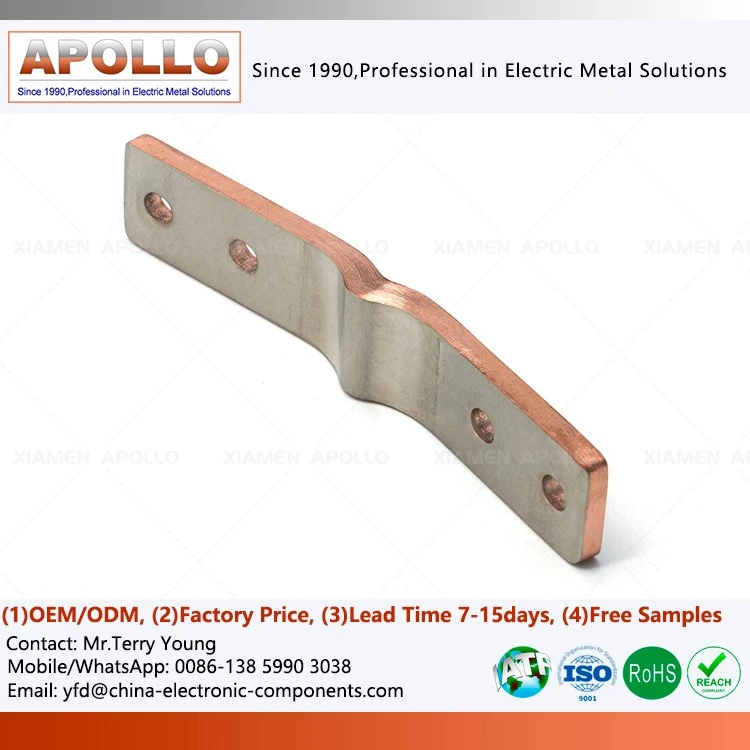


Copper Foil Laminated Flexible Bus Bars
Products Description

The defining characteristic of Copper Foil Laminated Flexible Bus Bars
is their stacked structure comprising multiple layers of copper foil. Each foil layer typically ranges from 0.05 to 0.2 mm in thickness, with the total number of layers varying from a few to several dozen-depending on current requirements-to form a flat, ribbon-like conductor. Shorter versions (ranging from tens to hundreds of millimeters in length) are suitable for battery packs in new energy vehicles, while longer or large-cross-section versions serve equipment such as power transformers and switchgear.
Design Advantages
Decoupling of Current-Carrying Capacity and Flexibility
In conventional designs, increasing current-carrying capacity typically requires increasing the cross-sectional area, which often compromises flexibility. The laminated structure of Flexible Laminated Flat Copper Busbar overcomes this limitation: current-carrying capacity is enhanced by increasing the number of layers (rather than the thickness of a single layer), while the ultra-thin nature of each copper foil layer ensures that flexibility remains virtually unaffected.
Multi-Layer Redundancy for Safety
For safety-critical battery connections, we employ an "N+2" layer redundancy scheme for Laminated Copper Busbar for Inverter. Even if two layers of copper foil were to break unexpectedly, the remaining layers could still carry the rated current while keeping the temperature rise below 85°C.
Stress-Relief Slots at the Terminals
In the transition zone between the terminal and the flexible section, we incorporate micro stress-relief slots into the Copper Inverter Laminated Busbar (0.5 mm wide, with a depth equal to 50% of the total layer thickness). These slots localize bending deformation to specific areas, preventing excessive stress from concentrating at the root of the terminal's welded interface.

Product Nature and Characteristics
Constructed by stacking layers of oxygen-free copper foil (0.05mm–0.3mm thick); features a design free from the strand-gap issues inherent in braided structures for Laminated Copper Busbar for Inverter.
The fusion zones at both ends are fully densified, free from delamination or voids, and offer electrical conductivity equivalent to solid copper busbars of the same specifications.
The flexible central section withstands repeated 180° bending without the strand breakage common in traditional Laminated Copper Insulated.
Surface finishes-such as full tin, nickel, or silver plating-can be selected to meet specific corrosion resistance and welding requirements.
Free from internal torsional stress in its natural state; imposes no additional torsional loads on connected components after installation for Flexible Laminated Flat Copper Busbar.

Manufacturing Advantages
High-Precision Cutting Lines
Copper Inverter Laminated Busbar is equipped with CNC laser and die-cutting machinery, achieving a copper foil cutting precision of ±0.05 mm; it ensures burr-free, deformation-free edges and superior stack flatness.
Vacuum Lamination Technology
Precise stacking of copper foil layers in a vacuum environment eliminates air bubbles and misalignment, ensuring uniform stack density and continuous electrical conductivity for Laminated Copper Insulated .
Molecular Diffusion Welding
Achieves atomic diffusion bonding between copper foil layers under high temperature and pressure (380–450°C, 15–30 MPa); weld strength equals or exceeds that of the base material, with no cold joints or porosity.
Integrated Terminal Forming
Welding and terminal processing are completed simultaneously, creating a seamless bond between the terminal and the copper foil body; ensures stable contact resistance and eliminates the risk of loosening for Flexible Laminated Flat Copper Busbar.

contact us
If you are looking for copper foil laminated flexible busbars for new energy vehicles, battery energy storage systems, power equipment, or industrial busbar systems, please contact us. Our engineering team offers custom design, rapid prototyping, and mass production support based on your drawings, current-carrying requirements, and installation space, helping your project achieve more reliable and efficient flexible conductive connections.

Hot Tags: copper foil laminated flexible bus bars, China copper foil laminated flexible bus bars manufacturers, suppliers, factory, Copper Foil Bus Bar, Copper Foil Connector, Copper Foil Flexible Busbar, Copper Foil Multi Layer Welding Busbar, copper foils flexible busbar, Flexible Copper Laminated Busbar
You Might Also Like


Send Inquiry