










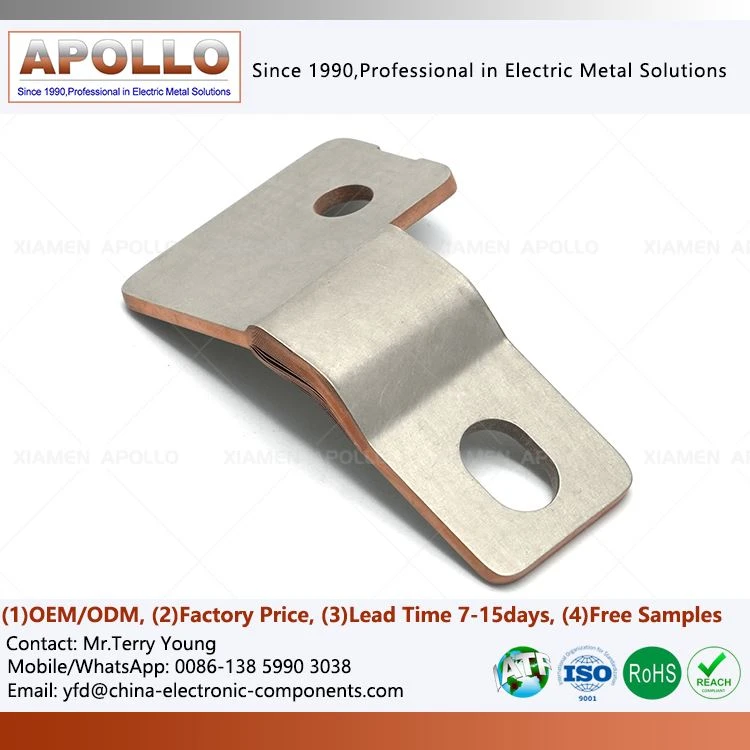

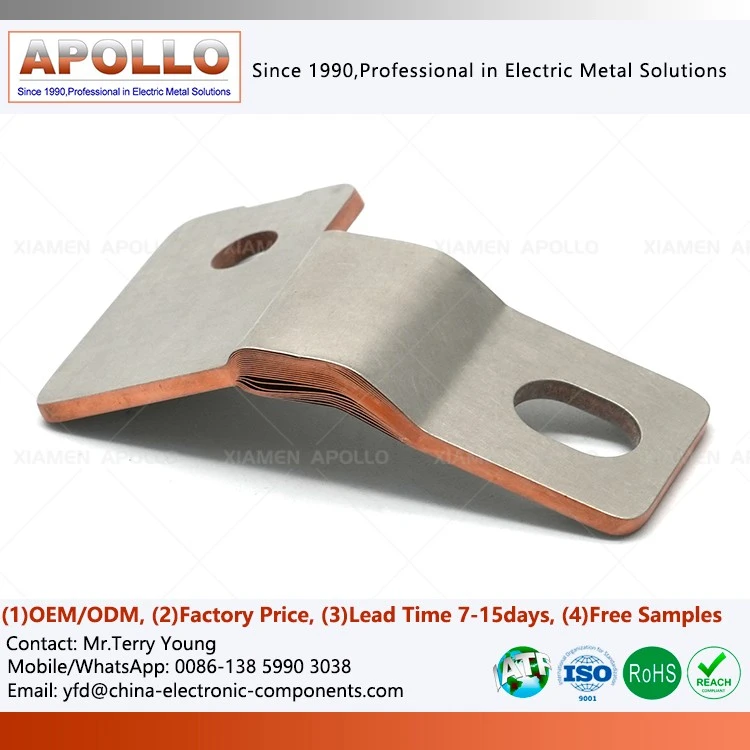
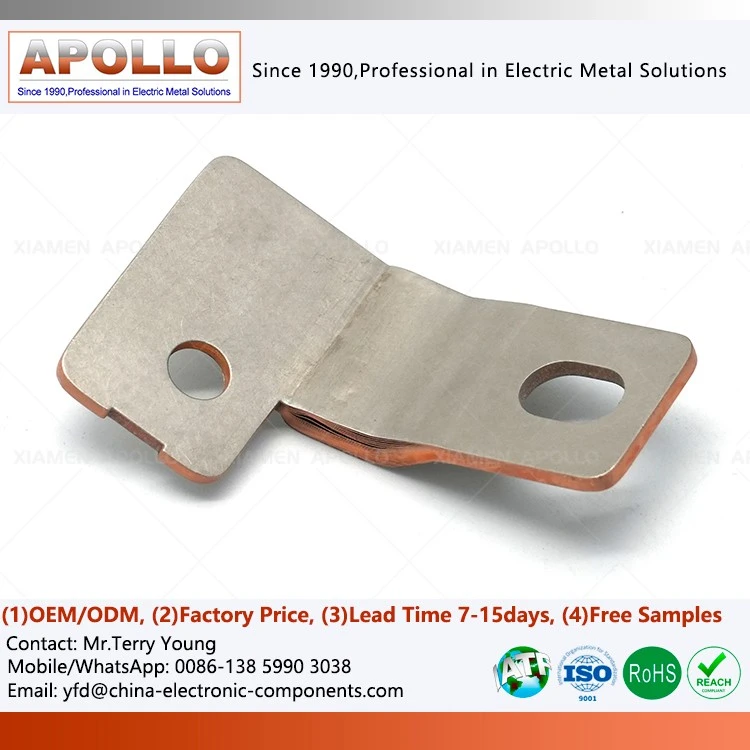

Copper Foil Busbar Used For High Current Voltage
What is Copper Foil Busbar Used for High Current Voltage?

This is not merely a case of "replacing rigid busbars with flexible cables"; rather, Copper Foil Busbar Used for High Current Voltage is a conductive connection component deeply optimized across the dimensions of material science, welding technology, and structural design. Its core principle involves replacing traditional rigid busbars or braided cables at high-current nodes with flexible segments-formed by laminating multiple layers of ultra-thin copper foil-thereby introducing "flexible compensation" capabilities to the system without compromising current-carrying capacity.
Smaller-sized products are widely used for series and parallel connections between battery modules in new energy vehicles, while larger versions facilitate high-current flexible transitions in electrical equipment such as transformers, rectifier cabinets, and switchgear. In any application, these copper foil flexible connectors are redefining the engineering boundaries of conductive connections: delivering the current-carrying capacity of rigid connections alongside the adaptability of flexible ones.
Manufacturing Process: The Art of Molecular Diffusion Welding
Precision Cutting and Surface Activation
Copper foils are precision-cut and shaped using specialized molds, followed by chemical cleaning and mechanical abrasion to thoroughly remove oxide layers and expose the fresh copper crystal lattice.
Vacuum Stacking and Pressurization
The cleaned copper foil layers are stacked according to design specifications and placed into specialized tooling within a vacuum or protective atmosphere.
Temperature-Controlled Diffusion Bonding
The assembly undergoes a prolonged heating process at temperatures no lower than 80% of copper's melting point. .
Integral Forming and Surface Finishing
Post-welding, the terminals undergo milling to ensure the flatness of mounting surfaces, followed by a final plating treatment.

Application Scope: From Cell Interconnects to Substation Corridors
Power battery packs for new energy vehicles represent a primary application area for compact, flexible copper foil connectors. Within the series-parallel circuits of prismatic cell modules, these connectors replace traditional cables and rigid busbars with superior space efficiency while handling high currents.
01
Energy storage containers and battery-swapping stations require solutions that balance high current capacity with ease of maintenance. The modular design of flexible copper foil connectors facilitates rapid installation and removal.
02
Large-scale flexible copper foil connectors have long been a staple in power transformers and reactors. Serving as the transitional link between transformer winding terminals and switchgear, their flexible structure mitigates the dual threats of electromagnetic vibration and thermal cycling.
03
In the high-amperage DC circuits found in electroplating power supplies and electrolysis equipment, flexible copper foil connectors act as jumpers between rectifier cabinets and plating tanks.
04

Detail Showcase: Precision Engineering Craftsmanship
Flawless Diffusion-Welded Transition Zone: The transition area between the terminal and the laminations exhibits a remarkably smooth metallurgical interface, free from noticeable steps, weld beads, or "cold-weld" layers caused by incomplete bonding.
Burr-Free, Chamfered Mounting Holes: The rear sides of the mounting holes are deburred and chamfered to ensure a flush fit against flexible copper busbars or aluminum housings, preventing localized stress indentations.
Interlayer Wetting and Cleanliness: The mid-section laminations are free of residual oil, and the plating is uniform in color with no signs of oxidation or blackening, reflecting a highly clean manufacturing environment.
Precision-Shrunk Insulation Sleeving: The insulation tubing fits tightly against the copper foil without bulging; the edges of the heat-shrink tubing at the ends maintain standard safety creepage distances, ensuring no interference with bolted connections.

contact us
Rather than relying on low-quality price wars, we leverage decades of technical expertise in high-voltage conductive connections, a rigorous IATF 16949 quality system, and robust R&D capabilities for custom engineering to provide zero-defect, maintenance-free, system-level connection solutions for your high-end equipment for Copper Foil Flexible Busbars.

Hot Tags: Copper Foil Busbar, Flexible Copper Foil Connector, Copper Foil Busbar for EV Battery, High Current Copper Busbar, Battery Copper Flexible Connection, Laminated Copper Foil Busbar, Copper Foil Expansion Joint, High Voltage Electrical Copper Connector, Busbar Car, Copper Flexible BusBar, Copper Foil Bus Bar, Copper Foil Flexible Busbar, Flexible Copper Laminated Busbar, Multilayer Bus Bar
You Might Also Like


Send Inquiry