










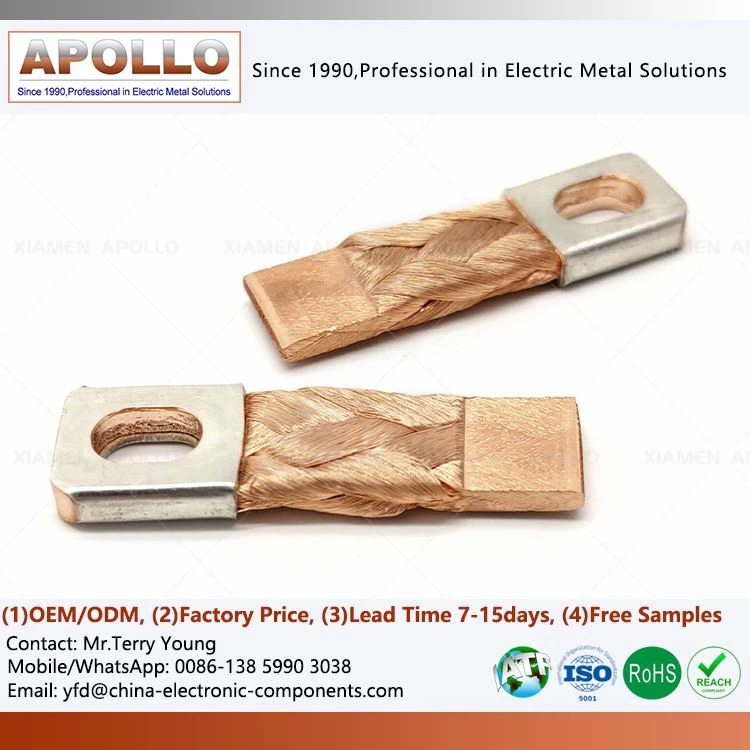
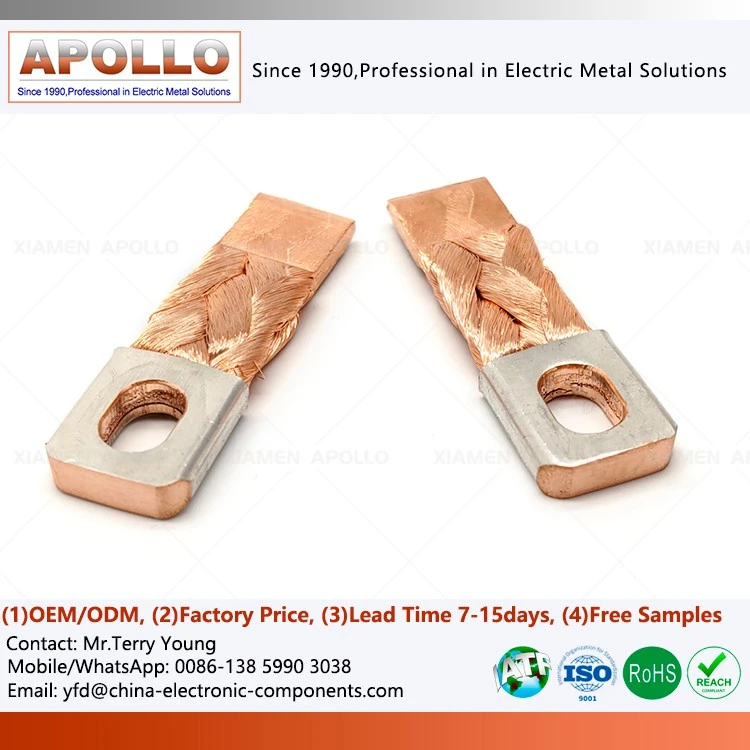
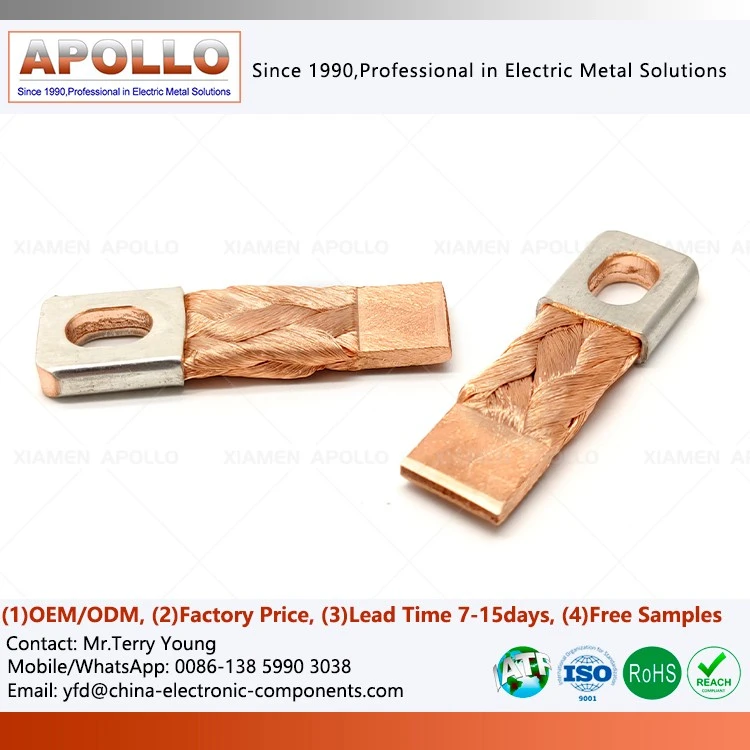
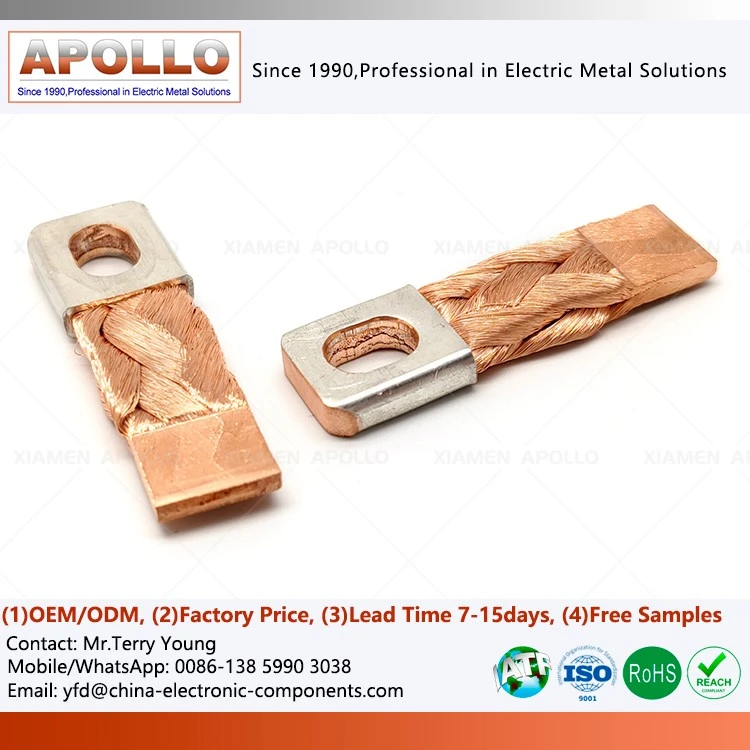
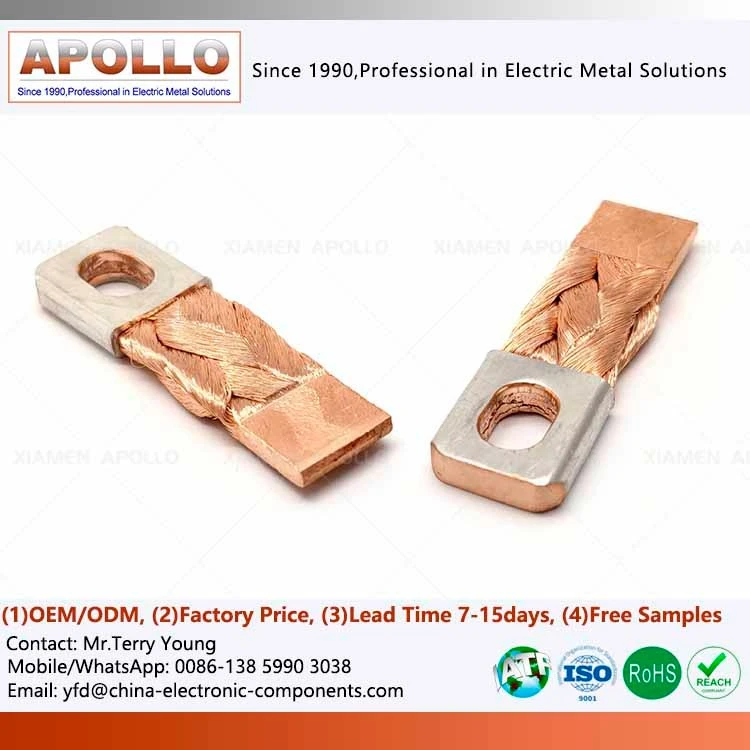
Copper Wire Braided Flexible Connectors
What is a Copper Wire Braided Flexible Connector?
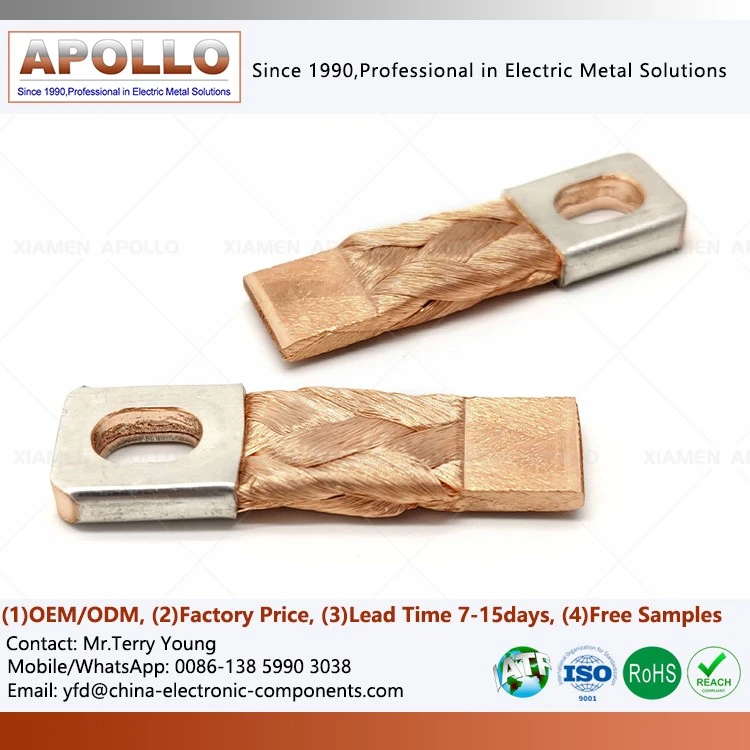
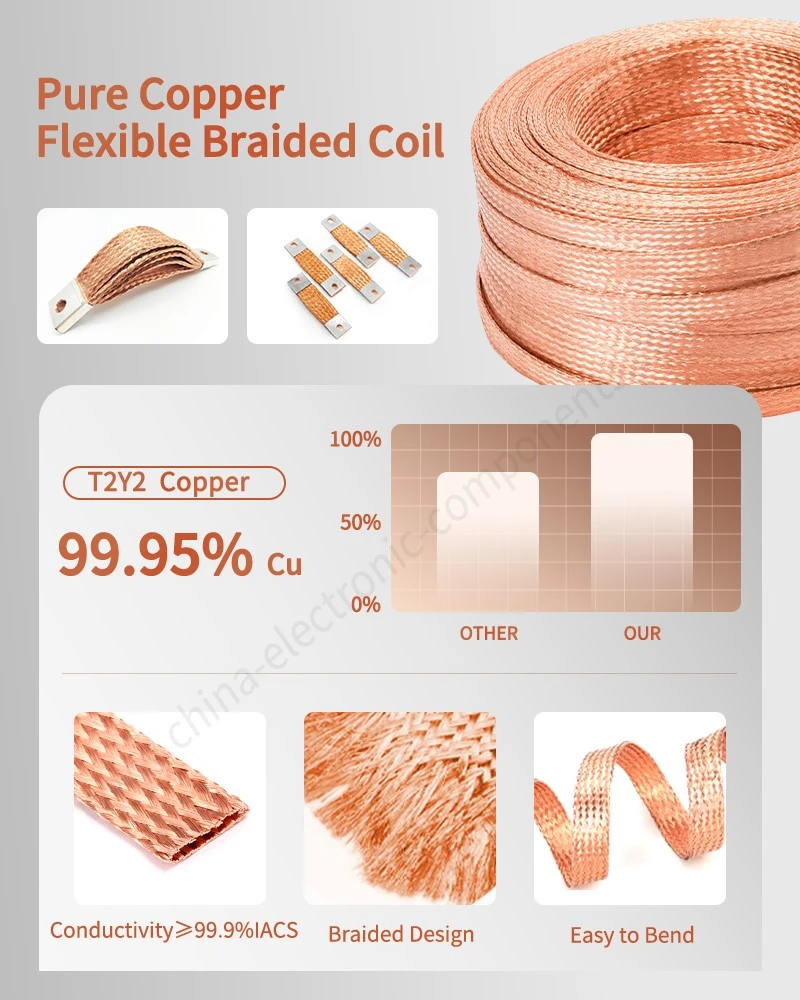
This high-current flexible conductor is made from braided copper strips that are laminated, compressed, and fitted with end connectors. It serves three fundamental functions:
Electrical Conductor: Made from pure or oxygen-free copper, it conducts current within the main circuit.
Flexible Structural Component: It maintains electrical conductivity even when bent, twisted, or offset, making it well-suited for compact installation spaces or applications involving relative displacement.
Compensation Element: It absorbs mechanical stress-arising from thermal expansion, vibration, or assembly tolerances-thereby protecting both the terminals and the equipment itself.
In short, it is a critical component in electrical connections that must simultaneously provide high conductivity, flexibility, and long-term durability. Consequently, every choice of material and manufacturing process directly determines the long-term reliability of the entire circuit.
Manufacturing Strengths for Flexible Braided Connectors
We are a manufacturer with full-chain production capabilities-not a trading company. This distinction is reflected in three key areas:
Direct Sourcing and Traceability of Raw Materials
Our oxygen-free copper wire and T2 copper terminal plates are sourced directly from vetted suppliers. Each batch comes with a material certificate (including traceability data such as heat/lot numbers), ensuring consistent copper purity and electrical conductivity.
In-House Control of Processes and Equipment
Parameters for all equipment-from high-speed braiding machines and fully automated terminal crimping machines to hot-press lamination systems-are set and locked by our internal engineering team. By eliminating reliance on external subcontractors, we maintain strict control over quality consistency.
Comprehensive Inspection System
Our three-tier quality assurance framework-covering incoming materials, in-process production, and finished goods-includes electrical conductivity testing, cross-sectional area verification, pull-force testing, plating thickness measurement, temperature-rise testing, and salt-spray testing. A detailed inspection report is provided with every shipment.
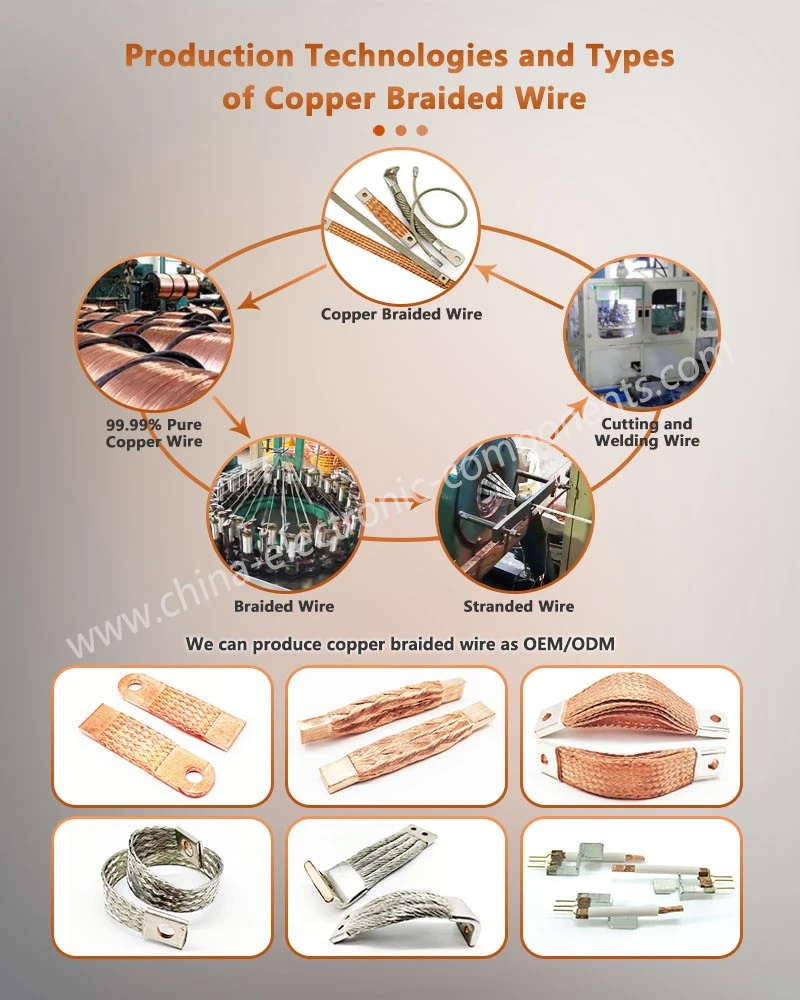
Detail Showcase: Assessing Craftsmanship Through Visible Features
For professional buyers, the quality of Braided Flexible Power Shunts can often be evaluated directly by examining the following details:
Braid Texture
Uniform pattern with no loose, broken, or snagged strands; edges are clean and free of burrs.
01
Laminated Edges
Clearly defined layer boundaries with no lifting or misalignment; smooth, well-compacted transitions.
02
Welded Areas
Continuous distribution of filler material; free from cold welds, incomplete welds, or significant discoloration caused by overheating.
03
Terminal Quality
Bolt holes are free of flash (excess material); contact surfaces are free of scratches or oxidation; consistent material thickness.
04
Insulation Covering
Tightly adhered with no air bubbles or damage; ends are neatly sealed.
05
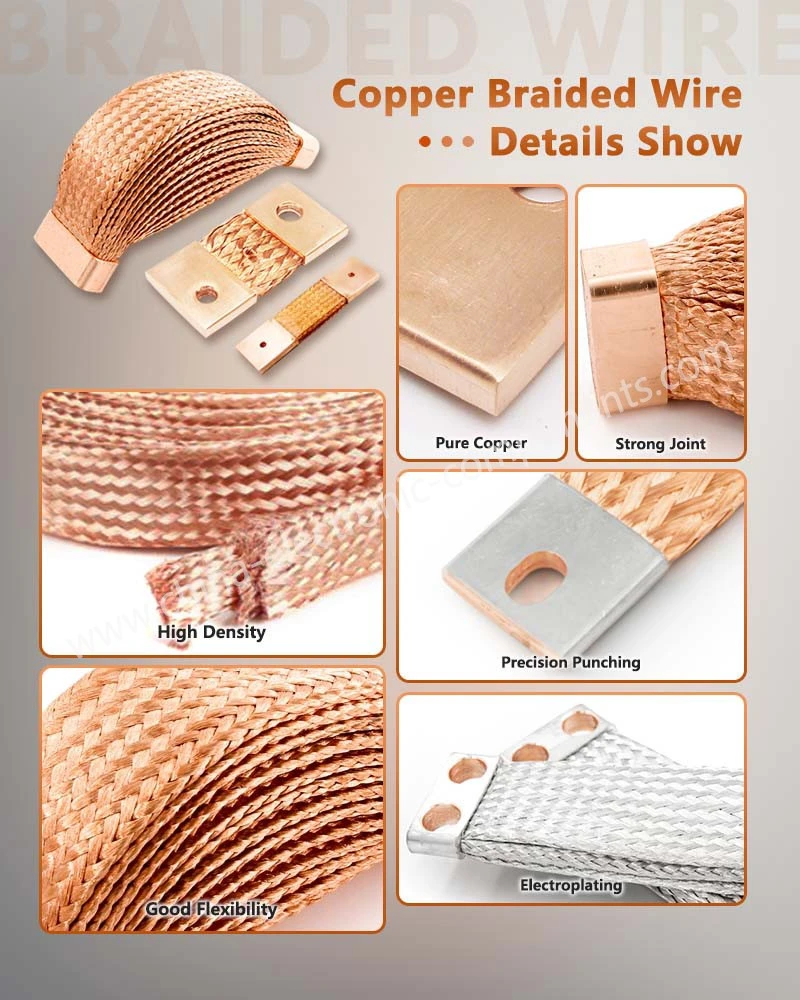
Frequently Asked Questions for Flexible Copper Braided Wire Connectors with Welded Ends
Q1: What is the fundamental difference between laminated copper braided flexible connectors and standard copper braided flexible connectors?
-
A: While standard braided connectors rely on their braided structure for flexibility, the lamination process utilizes controlled compaction to enhance contact stability between copper strands and ensure uniform current distribution. This reduces impedance and the risk of localized overheating-all while maintaining flexibility-making them better suited for high-current applications and long-term, reliable operation.
Q2: Can these products be customized to fit the specific space constraints of a battery pack or energy storage cabinet?
-
A: Yes. We offer customized designs-adjusting cross-sections, layer counts, lengths, and terminal configurations-based on your specific current ratings, installation dimensions, bending requirements, connection methods, and environmental conditions. We also provide comprehensive engineering support throughout the process.
Q3: How is long-term connection reliability ensured in environments subject to vibration or thermal expansion and contraction?
-
A: The flexible structure itself absorbs displacement and stress, while the lamination process improves internal contact stability. Furthermore, the use of robust crimping or welding at the terminals, combined with appropriate surface treatments, helps mitigate the risks of mechanical fatigue and contact degradation. Specific solutions are evaluated based on the actual vibration spectrum and temperature range.
Q4: How should surface treatments and protective coatings be selected?
-
A: For standard, dry indoor environments, tin plating is typically used to improve solderability and oxidation resistance. In humid, salt-spray, or outdoor environments, nickel plating or other protective coatings may be considered; additional insulation-such as heat-shrink tubing or dip-coated plastic-can also be applied if necessary. The final choice depends on the specific operating conditions and assembly processes.
Q5: What is the typical engineering collaboration process, from initial inquiry to final delivery?
-
A: We generally begin by confirming a preliminary design based on the current, voltage, space, environmental, and terminal requirements you provide. This is followed by sample validation and the finalization of mass-production processes. Our focus is on engineering alignment and process control, rather than competing solely on price.
contact us
We specialize in the custom engineering and volume production of highly reliable flexible copper braided connectors. With comprehensive capabilities-spanning material selection and structural design to process validation-we provide tailored solutions designed to meet your specific operating conditions and spatial constraints. Please submit your application parameters and technical requirements; our engineering team will assist in evaluating them and provide targeted recommendations.
Hot Tags: Copper Wire Braided Flexible Connectors, Copper Braided Flexible Connector, High Current Copper Flexible Connector, Copper Braid Flexible Link, braided copper wire, Braided Flexible Copper BusBar, Copper Tinned Wires, Flat Copper Braided Wire, Flexible Braided Connectors, Twisted Copper Wire
You Might Also Like


Send Inquiry