











Brazed Electrical Contacts
Products Description
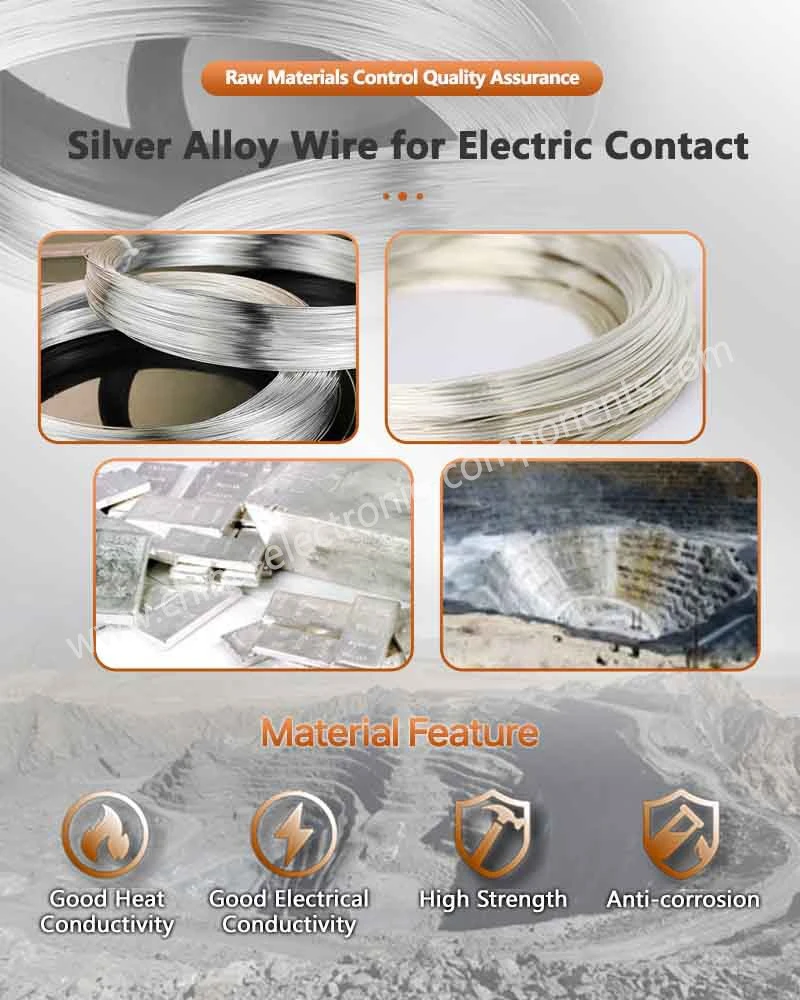
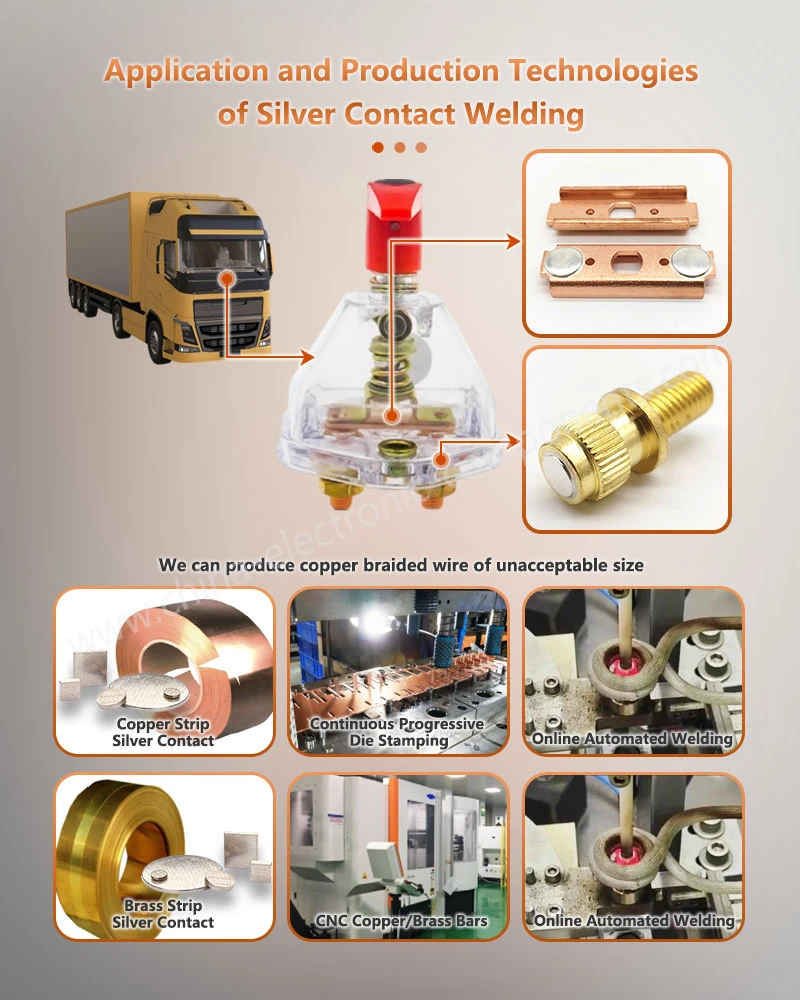
Brazed electrical contacts are electrical contact elements that firmly bond silver-based contact materials to copper, brass, or other conductive substrates using a high-temperature brazing process.
This structure combines excellent conductivity and mechanical strength, and is widely used in low-voltage electrical appliances, new energy systems, automotive electrical systems, home appliances, and industrial automation equipment. It is a key component for achieving highly reliable current conduction and long-life electrical breaking.
Compared to traditional riveted contacts, Projection Welding Silver Contacts offer advantages in thermal conductivity, resistance to welding, and connection stability. The brazing process ensures a metallurgical bond between the contact and the base, resulting in lower resistance, higher mechanical stability, and the ability to maintain stable performance over long periods under high-current surges and frequent interruptions.

Materials Collaborative Engineering
| Electrochemical Selection of Contact Materials | We utilize a series of alloys, including AgNi, AgSnO₂, and AgCdO, smelted under controlled atmospheres, with metallographic uniformity controlled within micron-level segregation. Crucially, we offer consultative material selection services tailored to your load characteristics (resistive, inductive, capacitive) and breaking frequency, rather than simply selling standard grades. For example, for high-frequency switching scenarios, we recommend AgSnO₂ materials with trace elements, whose oxide film breakdown voltage and Resistance Spot Welding Silver Contact resistance balance point is pre-optimized. |
| Compatibility Design of Solder Interface | The solder selection follows the "gradient matching" principle: a three-layer transition structure of thermal expansion coefficient, electrical conductivity, and melting point is constructed between the silver alloy and the copper base. Silver-copper-phosphorus (Ag-Cu-P) or silver-copper-zinc (Ag-Cu-Zn) solders are used, with the wetting angle controlled below 15° to ensure capillary flow is completed within a rapid heating cycle of less than 5 seconds, avoiding high-temperature phase transformation of the Flash Welding Silver Contact material. The solder layer thickness is precisely maintained within the range of 0.08-0.15mm, ensuring mechanical strength while preventing abnormal resistivity increases due to excessive solder thickness. |
| Substrate Topology Optimization | The conductive base uses extra-hard T2 copper or chromium-zirconium copper (CuCrZr). The key difference is that the latter maintains 97% IACS conductivity while increasing the annealing temperature resistance to over 550℃. For high-current applications, a micro-heat sink structure is embedded within the substrate to reduce steady-state temperature rise by increasing the heat exchange area. This integrated design reduces the number of thermal interfaces compared to traditional assembly methods, shortening the heat conduction path by more than 40%. |
Technical Language of Performance Advantages
Time-Domain Stability of Contact Resistance: Initial contact resistance is below 5 μΩ (at a 10 A test current), and after 10,000 mechanical life cycles, the resistance increase is limited to within 15%. This stability stems from the controlled thickness of the diffusion zone formed by the solder layer and the two base materials, ranging from 2-5 μm. This ensures metallurgical bonding strength while avoiding the embrittlement risk associated with excessively thick diffusion zones.
Microscopic Mechanism of Anti-Fusion Welding Capability: For applications potentially subject to short-circuit impacts, microtextured structures (laser-etched grid grooves) can be added to the Electric Resistance Welding Silver Contact surface. These grooves act as channels for metal vapor escape under the high temperature of the electric arc, preventing large-area melting and adhesion of the contact surface. The depth and width of the microstructure are precisely designed based on the expected short-circuit current peak, demonstrating a cross-scale correlation between macroscopic performance and microscopic morphology.
System-Level Optimization of Temperature Rise Characteristics: Component temperature rise depends not only on the material itself but also on its geometry. Our design follows the principle of "isothermal optimization," adjusting the cross-sectional gradient curve of the copper base to ensure a uniform temperature gradient distribution across the entire module under operating current, thus eliminating localized hot spots. Actual measurement data show that the optimized module can reduce its maximum temperature by 8-12K under the same conditions.

Cross-Industry Application Adaptation
New Energy Inverter Field
In photovoltaic or energy storage inverters, the DC side switching frequency is low, but the current ripple is large. We recommend AgNi material combined with a thickened copper base design to suppress Joule heat accumulation. For the AC side, AgSnO₂ material is used, whose anti-AC oxidation properties are verified by IEC 60947-4-1, maintaining clean Resistance Seam Welding Silver Contact surfaces under 50/60Hz operating conditions.
Rail Transit Control Systems
For the EN 45545 flame-retardant standard, we provide cadmium-free material solutions. The solder also uses a phosphorus-free formula to meet low-smoke and halogen-free requirements. The components have passed triaxial durability tests with vibration frequencies of 5-150Hz and accelerations of 5g, and the solder fatigue life exceeds 10⁷ cycles.
Industrial Servo Drives
Servo systems require microsecond-level response, and the contact bounce time needs to be compressed to less than 1ms. By optimizing the Silver to Copper Brazing mass distribution and matching the spring preload, our components can control the initial closing bounce height to within 0.05mm. Simultaneously, maintaining low contact resistance reduces signal transmission distortion, which is crucial for the stability of the current loop in precision position control.
Smart Grid Switchgear
Used as main or bypass Copper Bars Silver Contact Joinings in 12kV medium-voltage switchgear. The solder joints must withstand not only a rated continuous current of 1250A but also a short-time thermal stability current of 75kA/1s. Employing a CuCrZr base and vacuum brazing process ensures zero risk of solder remelting under extreme thermal shock, guaranteeing grid-level reliability.
contact us

Hot Tags: brazed electrical contacts, China brazed electrical contacts manufacturers, suppliers, factory, Spot Welding Silver Contact, AC Resistance Welding Silver Contact, Brazed Contacts, Contact Joining Brazing, Resistance Welding Silver Contact, Welding Electrical Silver Contact Tip Assembly
You Might Also Like


Send Inquiry