











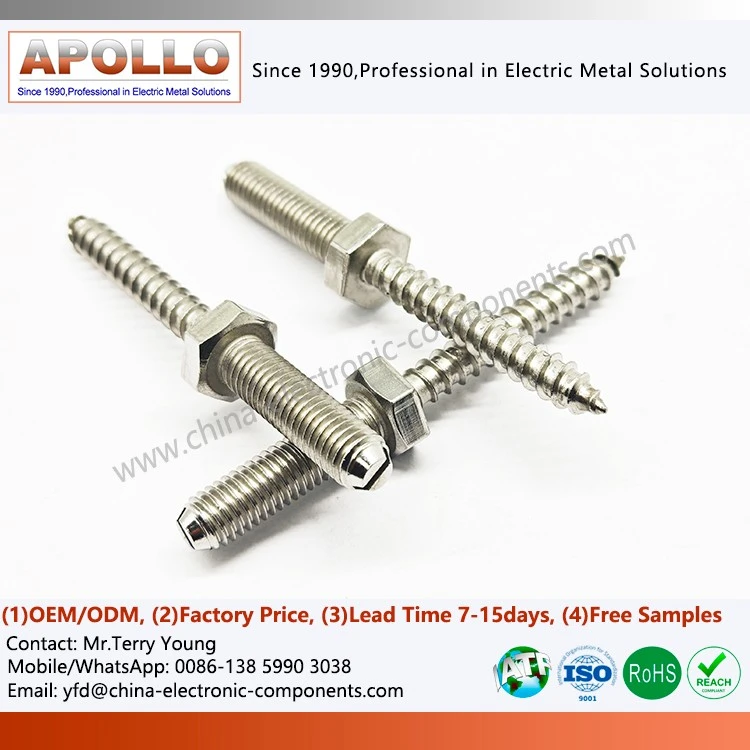


Double Ended Threaded Bolt
Products Description

A double ended threaded bolt, also known as a double-ended bolt or a double-threaded shank, refers to a fastening element with threads at both ends and a smooth or fully threaded shaft in the middle.
Its design allows it to connect to two nuts or internal threaded holes simultaneously, achieving bidirectional locking, fixing, positioning, and force transmission functions.
Typical features include:
Equal or non-equidistant threaded structures at both ends, customizable to fit the assembly depth;
The middle section can be a round shaft, a hexagonal shaft, or fully threaded.
Precision-machined or rolled threads are available to ensure accuracy and tensile strength.
High corrosion resistance and stable torque transmission performance.
This structure is particularly suitable for use in scenarios requiring frequent disassembly and assembly or subjected to alternating loads, effectively preventing loosening and extending equipment life.
Product Advantages
Superior Assembly Flexibility and Tolerance
Double-ended studs decouple the "fixing" and "tightening" actions. Once the screw-in end is installed, it serves as a positioning reference. Subsequent assembly only requires operating the nut on the other end, greatly simplifying the assembly process for large or complex components, especially suitable for situations where space is limited or hole alignment is difficult.
Unparalleled Fatigue and Vibration Resistance
The screw-in end forms a deep thread engagement with the base material, essentially acting as a single unit, effectively preventing loosening that may occur with ordinary bolts under vibration. Its smooth shank, free of stress concentration, results in a fatigue life far exceeding that of Double-Ended Threaded Bar of the same material under alternating loads.
Protection of the Base Material and Reusability
Compared to ordinary Twin-End Bolt, which may damage the base material threads through repeated screwing and unscrewing, the screw-in end of a double-ended stud remains stationary after initial installation. Only the nut end is operated, effectively protecting the threads of precision or valuable equipment and extending the equipment's service life.
High-strength system connection
By selecting high-strength alloy steel materials and combining them with reasonable quenching and tempering heat treatment, double-ended screws can achieve strength grades of 10.9, 12.9, or even higher, providing a solid connection guarantee for heavy-duty and high-stress applications.

Process Depth: The Transformation from Wire Rod to Premium Product
Material Selection and Pre-treatment
Double-Headed Machine Screw: Selecting the optimal steel grade based on the application scenario and achieving the best cold-working structure through spheroidizing annealing.
01
Multi-station Cold Heading
On a precision cold heading machine, processes such as cutting, preliminary forging, and finishing are used to form the intermediate smooth rod and end blanks.
02
Precision Thread Rolling
On a precision thread rolling machine, two or three thread rolling rollers simultaneously extrude the thread to form a high-strength, high-precision thread profile.
03
Heat Treatment Strengthening
Through a quenching and high-temperature tempering process, a high-strength grade with a tensile strength of over 800 MPa is obtained.
04
Surface Treatment Optimization
Two-Sided Bolt: Selecting the most suitable surface treatment based on corrosion resistance requirements, such as Dacromet, hot-dip galvanizing, or phosphating.
05

Materials Science: Performance-Oriented Alloy Design
High-Strength Alloy Steel Selection
Two-end Stud Bolt Selecting high-quality alloy steels such as 35CrMo, 42CrMo, or SCM440 based on strength requirements to achieve a perfect balance between strength and toughness.
01
Corrosion-Resistant Material Systems
Providing 304/316 stainless steel or special anti-corrosion coating solutions for special environments, meeting the needs of different corrosion levels.
02
High-Temperature Material Development
Dowel Screw: Developing special alloy formulations for high-temperature applications to maintain stable mechanical properties and relaxation resistance at high temperatures.
03
Microstructure Control
Both-Ended Screw Obtaining a fine, uniform sorbite structure through precise heat treatment process control to ensure consistent performance.
04

contact us

Hot Tags: double ended threaded bolt, China double ended threaded bolt manufacturers, suppliers, factory, Dual End Screw, Stainless Steel Pocket Screws, Steel Set Screw, Slotted Cheese Head Screws, Self Forming Screw, Flanged Hexagon Head Bolt Screw
You Might Also Like


Send Inquiry