










Failure Physical Analysis and Early Warning Methods for Electrical Contact Rivets For Switches
May 25, 2026
Leave a message
In the high-voltage circuits of new energy vehicles and energy storage systems, relay adhesion is one of the most serious failure modes. The operating state of Electrical Contact Rivets for Switches directly affects equipment safety. Once adhesion occurs, the controlled circuit cannot be disconnected normally, which may lead to battery over-discharge, equipment malfunction, or even safety accidents. A deep understanding of the underlying physical nature and the establishment of an effective early warning mechanism are crucial for ensuring the safety of high-voltage electrical systems.
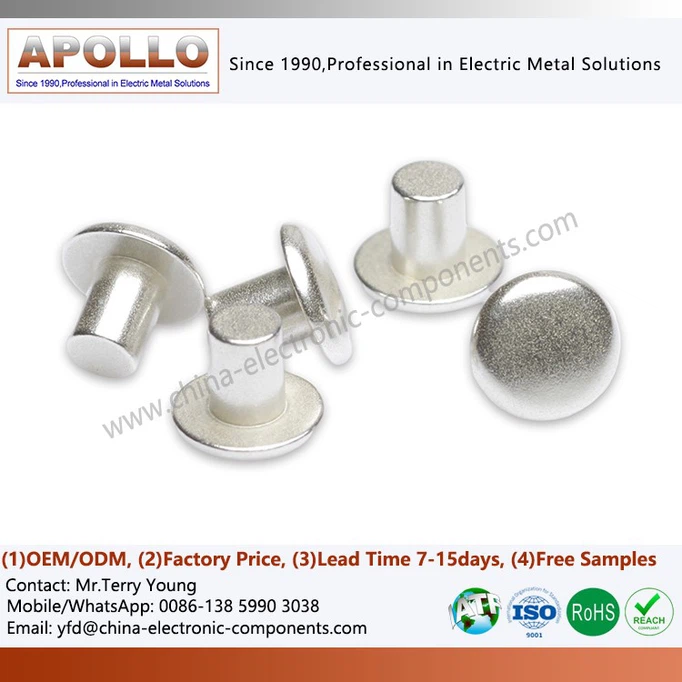
Microscopic Physical Mechanism of Adhesion Failure
Adhesion in Solid Silver Contact Rivets does not occur instantaneously, but is a process of accumulated damage over multiple operations, ultimately leading to a qualitative change from a quantitative one. Its core physical mechanism mainly includes two aspects: metal fusion welding and material transfer accumulation.
Metal fusion welding usually occurs when interrupting large currents, especially short-circuit currents. The intense electric arc generated during the separation of Solid Contacts Rivets causes the local temperature in the contact area to momentarily exceed the melting point of the materials (e.g., silver's melting point is approximately 960°C), forming a pool of molten metal. When the arc extinguishes, this molten metal rapidly cools and solidifies, bonding the two components together like a weld. This adhesion often occurs suddenly and is highly strong.
Material transfer and accumulation, however, is a more subtle and gradual process. During frequent switching operations, due to the directionality of the arc and electrothermal effects, material in the Silver Electrical Contact Rivets migrates directionally from one electrode to the other. Over time, sharp "burrs" or protrusions may form on the surface of one component, while corresponding pits form on the surface of the other. When the mechanical interlocking effect of the protrusions and pits reaches a certain level, or when the contact surface becomes abnormally rough due to material transfer, leading to a surge in the actual contact area and concentrated pressure, even without a large arc, mechanical jamming or cold welding effects may prevent separation, resulting in adhesion.
Early Warning Method Based on Multi-Parameter Fusion
Given the monitorable signs during the latency period before adhesion occurs, early warning can be achieved by analyzing the dynamic electrical parameters of the relay in real time, ensuring the stable operation of the Electrical Contact Rivets for Socket. The core lies in capturing subtle shifts in the operating characteristics and contact states.
One of the most effective early warning parameters is dynamic contact resistance. By superimposing a high-frequency detection signal onto the load current, the resistance between Pure Ag Silver Contact Rivets in the closed state can be measured in real time. Although this resistance value is small, it is extremely sensitive. When the component surface begins to roughen due to slight arc erosion, or when contact pressure changes due to material transfer, the dynamic contact resistance will show a slow upward trend. Monitoring the slope of this trend can help determine in advance whether the contact state is continuously deteriorating.
Another key early warning indicator is the pull-in and release time. After the coil is energized, the time required for the armature to drive the Pure Silver Solid Contact Rivet for Switches from the start of movement to complete closure is the pull-in time; conversely, it is the release time. As the mechanical mechanism wears or lubrication ages, the resistance to movement increases; or as the surface condition of the components changes, the attraction force changes. These will all lead to a systematic increase or decrease in the operating time, and an increase in fluctuation (variance). By monitoring the statistical characteristics of the operating time through a high-precision timing circuit, abnormalities in the mechanical and magnetic circuit states can be effectively identified.
Coil current waveform analysis also provides crucial information. In a healthy relay, the coil current exhibits a characteristic dip at the moment of pull-in due to the presence of back electromotive force. If the movement of the Customized Electrical Contacts is obstructed or there is a slight deformation in the magnetic circuit, the characteristic points of this current waveform (such as dip depth and time position) will shift. Subtle differences can be detected by comparing historical normal waveforms with real-time waveforms.
The essence of failure in new energy relays is the gradual failure of materials and structures under the coupling of multiple electrical, thermal, and mechanical fields. The material properties and structural design of the Electrical Silver Contact Points are key influencing factors. By real-time monitoring of dynamic contact resistance trends, statistical characteristics of operating time, and waveform features of coil current, a multi-parameter fusion early warning model is constructed. This model can identify early signs of performance degradation before irreversible physical adhesion occurs. This condition-monitoring-based predictive maintenance strategy transforms system protection from reactive fault handling to proactive risk prevention, opening up a new technical path for improving the overall reliability and safety of high-voltage electrical systems.

Our meticulously developed and manufactured Electrical Contact Rivets for Switches utilize high-quality alloy raw materials and optimized internal structural proportions to effectively resist arc erosion and material loss, significantly reducing the probability of equipment adhesion failures. They are compatible with various high-voltage relay equipment in the new energy sector, ensuring long-term stable operation of electrical circuits. We welcome inquiries and purchases from customers in all sectors and look forward to in-depth cooperation.
contact us

Send Inquiry