


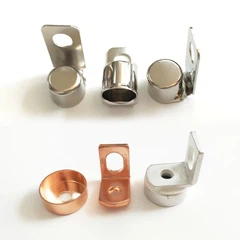


Blade Fuse Block Links
Products Description

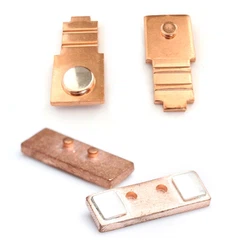
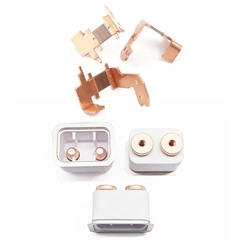
Blade fuse block links are components specifically designed for high-speed fuses; they are assembled from aluminum alloy caps and highly conductive oxygen-free copper contact blades using a precision riveting process. These components establish low-resistance electrical connections at both ends of the fuse while providing a mechanical interface for insertion and extraction. Widely used in applications such as semiconductor protection, DC-side energy storage systems, UPS bypass circuits, and high-voltage power distribution units for electric vehicles, they are required to maintain the structural integrity of the contact blades and ensure stable electrical conductivity, even under conditions demanding high breaking capacity.
Manufacturing Process
Copper Strip Preparation and Slitting: T2 copper strip compliant with the GB/T 5231 standard is selected based on Forged Copper Components specifications and slit to size according to the contact blade's unfolded dimensions. Strip thickness is determined by the rated current, typically ranging from 0.8 mm to 3.0 mm.
Copper Contact Blade Stamping: A high-speed press equipped with a multi-station progressive die is used to perform blanking, bending, chamfering, and marking (embossing) in a single operation, forming the semi-finished contact blade. Specialized stamping oil is applied during the process for lubrication and cooling, ensuring a smooth cut surface.
Contact Blade Surface Cleaning: The stamped High-Speed Fuse Contact undergo hydrocarbon or ultrasonic cleaning to remove surface oils and stamping residues, ensuring optimal adhesion for subsequent plating.
Contact Blade Surface Treatment: The Fuse Links With Knife Contacts are tin-plated or silver-plated according to customer requirements. Tin plating thickness is typically controlled at 3–5 μm, while silver plating ranges from 2–5 μm. Post-plating adhesion tests are conducted to verify the bond strength between the plating and the base material.
Aluminum Alloy End Cap Forming: End caps are produced either by CNC turning extruded aluminum rods or by stamping aluminum alloy strips. Rated parameters and model identifiers are applied to the end cap face via screen printing or laser marking. The formed end caps undergo anodizing or chemical passivation.
Riveting and Assembly: Automatic press-riveting equipment is used to join the aluminum alloy end caps and Fuse Link Blade. Riveting force or displacement is monitored in real-time during the process to ensure consistent riveting quality.

Product Advantages
Extreme Weight Reduction
While maintaining required current-carrying capacity and mechanical strength, non-conductive core fastening zones and peripheral components have been replaced with aluminum alloy, reducing the total mass of the Forged Copper Components by 38% to 44%. This effectively alleviates dynamic cantilever stress on the wiring harness box base, preventing fatigue fractures at the connection point caused by prolonged vibration.
Superior Transient Heat Dissipation
The geometric surface area of the High-Speed Fuse Contact has been optimized via topology, resulting in a heat dissipation coefficient 15% higher than that of a single thick copper busbar. During short-circuit transient surges, the design rapidly distributes and conducts localized heat, ensuring the fast-acting fuse element trips precisely according to its rated energy value (I²t).
Long-Term Mechanical Contact Stability
The oxygen-free Fuse Link Blade area exhibits high creep resistance; it resists physical relaxation even under sustained clamping force from spring clips, maintaining consistent contact pressure for over 15 years.

Frequently Asked Questions
Q: How is the strength of the riveted joint verified for the Fuse Link Blade?
A: Destructive testing is performed using a specialized shear force test rig to simulate actual operating conditions and record the maximum shear force and failure modes. Sampling tests are conducted for each batch to establish quality control records.
Q: How should the Fuse Links With Knife Contacts' electrical ratings be selected?
A: The operating voltage must be equal to or greater than the system's maximum operating voltage. For the current rating, it is recommended to select 125%–150% of the system's operating current to ensure sufficient margin and reliability. Please consult our technical team for detailed selection guidance.
Q: How does the riveting process affect electrical performance for Forged Copper Components?
A: The riveting process avoids the heat-affected zones associated with welding, ensuring long-term stability of the contact resistance at the aluminum-copper interface. Testing shows a contact resistance variation of less than 5% after 1,000 mating cycles, outperforming welded solutions.

contact us
Please contact our engineering team for technical specifications, sample requests, or custom solutions regarding Blade Fuse Block Links. We provide professional support to help you optimize the design and performance of your circuit protection systems.

Hot Tags: blade fuse block links, China blade fuse block links manufacturers, suppliers, factory, Blade Fuse Terminal, Copper Knife Contact, fuse contact blade, fuse contact cap, Fuse Knife Contact, Nh Fuse Links Knife
You Might Also Like


Send Inquiry