











Tin Coated Insulated Flat Copper Bus Bar For Battery
What is A Tin Coated Insulated Flat Copper Bus Bar for Battery?

Busbar failures are rarely caused by "copper itself is not conductive", but almost always occur in these four weak links: the oxide film on the copper surface causes the contact resistance to increase year by year; fretting wear (fretting) occurs at the bolt joints under vibration; moisture, heat, and dust form creepage channels on the insulation surface; and additional stress caused by the accumulation of assembly tolerances. Therefore, we focus the design on interface reliability rather than simple cross-sectional area:
The tin layer isolates copper from air and inhibits oxide film formation. At the same time, relying on the softness and self-lubricating properties of tin, it fills microscopic gaps during crimping/bolting, stabilizes contact resistance, and retains subsequent solderability. The thickness of the tin layer is selected according to the service level of ASTM B545 / ISO 2093 (common Class B/C/D) according to the working conditions, rather than uniformly "thickening".
The function of the dip-coated layer is to conform to the copper matrix to form a continuous film layer without overlapping seams. It also completely covers the bending, punching, and special-shaped ends to avoid the failure path of "end opening-capillary moisture absorption-edge corrosion first" common in casing solutions.
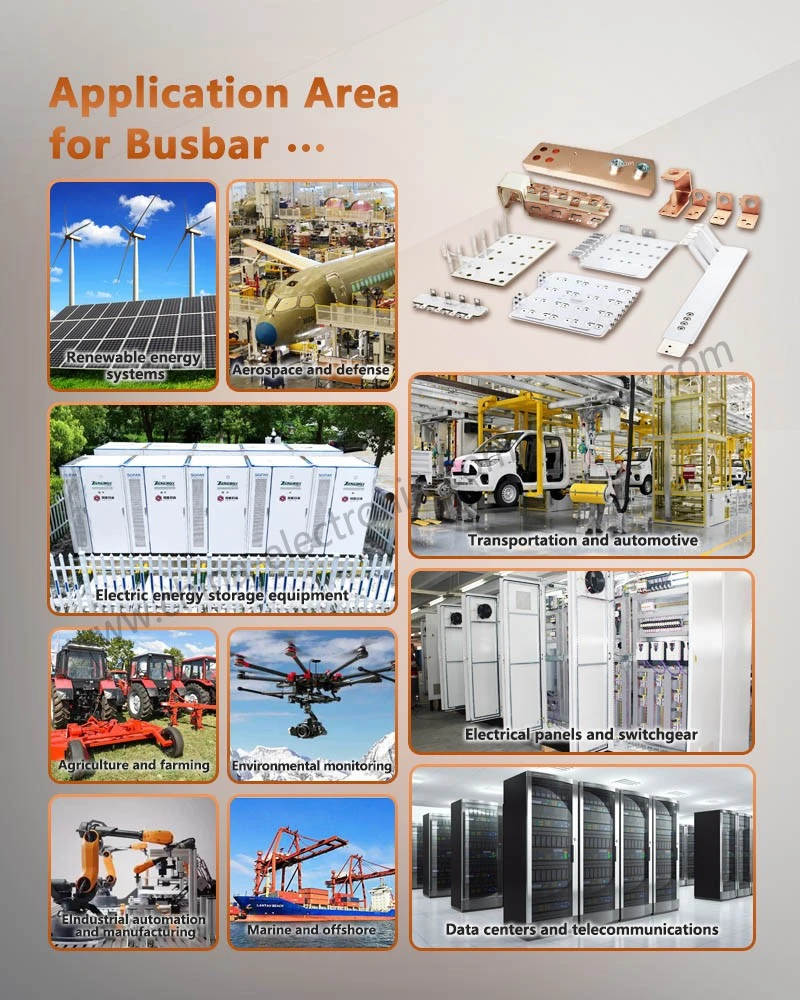
PVC Coated Bus Bars Application Scenario Advantages
New Energy Vehicles (EV/PHEV Battery Packs)
Used for main circuit connections between power battery modules (Module-to-Module) and between the pack and the BMS or High-Voltage Power Distribution Unit (PDU). Features vibration resistance and flame retardancy, while withstanding the high-humidity and thermal cycling conditions of the vehicle compartment.
Commercial, Industrial, and Residential Energy Storage Systems (Solar PV & BESS)
In high-capacity LFP battery cabinets, the flat profile facilitates the high-density stacking of multi-layer battery clusters; low power loss helps improve the overall Round-Trip Efficiency (RTE) of the energy storage system.
High-Frequency Inverters and Power Conversion Equipment (Solar Inverters & Power Conversion)
High-frequency DC busbar segments require extremely low inductance and excellent heat dissipation; tinned, insulated copper busbars serve as an effective replacement for bulky, difficult-to-install thick cables.
Detail Showcase: Engineering Craftsmanship in the Fine Details of Dip Insulated Busbar
Exposed Copper-Free End Faces
The end faces of the copper busbar undergo a specialized process to ensure no bare metal remains after insulation wrapping, thereby eliminating any potential risk of short circuits.
Identification and Traceability System
Laser marking is used to permanently apply material codes, production batch numbers, and polarity indicators (positive/negative) in inconspicuous locations, facilitating error prevention during production and simplifying future maintenance.
Edge Chamfering and Deburring
All sheared edges undergo precision deburring and rounding to prevent sharp corners from puncturing the insulation layer during assembly or thermal expansion/contraction, thereby extending the insulation's service life.
Contact Surface Flatness Control
Areas designated for connection to battery cell terminals or busbar connectors undergo specialized flatness calibration; this ensures a high degree of surface contact and minimizes contact resistance when tightened to the specified torque.

Frequently Asked Questions for PVC Insulated Copper Busbar
Q1: How should I choose between tin-plated and nickel-plated copper busbars for batteries?
-
Tin plating offers a balanced choice if you prioritize solderability, cost control, and general corrosion resistance. Nickel plating is worth considering if the busbar will operate at higher temperatures or requires superior wear and chemical corrosion resistance. Tin plating is the preferred choice for most battery modules and energy storage busbar applications.
Q2: What are the key differences between dip-coated insulation and heat-shrink tubing?
-
Dip coating creates a continuous, seamless layer that conforms precisely to the substrate without overlapping seams or openings. It provides complete coverage for complex shapes and bent parts, preventing edge corrosion caused by capillary moisture absorption at the ends of tubing; it also allows for tighter installation spacing.
Q3: Is a thicker tin layer always better?
-
No. A layer that is too thin may be porous and offer insufficient protection, while an excessively thick layer increases costs and the risk of tin whisker growth. Selection should be based on the service environment in accordance with ASTM B545 / ISO 2093 standards: Class B/C for general environments, and Class D for high-humidity, high-salinity, or engine compartment conditions.
Q4: Can you provide customization for bending, punching, and insulation cutouts based on drawings?
-
Yes. We offer customization services starting with a drawing review. We provide Design for Manufacturability (DFM) feedback regarding bending radii, hole position tolerances, insulation cutout dimensions, and assembly tool clearance, ensuring consistent delivery from small-batch prototyping to mass production.
Q5: What verification documents are provided upon acceptance?
-
We routinely provide reports on material composition and plating thickness; data from adhesion, withstand voltage, and salt spray tests; full dimensional inspection records; and batch traceability information. We can also facilitate third-party testing and customer factory audits when project requirements dictate.

contact us
If you have a Custom Solid Power Bus Bar with Insulated Dipping Tube drawing, 3D model, or electrical requirement, send it to our engineering team for a manufacturability review and a customized busbar solution based on your actual assembly conditions-not a price-only quotation.

Hot Tags: Tin Coated Insulated Copper Bus Bar, Insulated Flat Copper Bus Bar, Battery Copper Busbar, Tin Plated Copper Busbar, EV Battery Busbar, Insulated Copper Busbar, Battery Bus Bar, Busbar Coating Powder, Dip Insulated Busbar, Epoxy Powder Coated Busbar Insulation, Insulating Coatings Busbar, PA66 Plastic Insulation Busbar, PVC Coated Bus Bars
You Might Also Like


Send Inquiry