










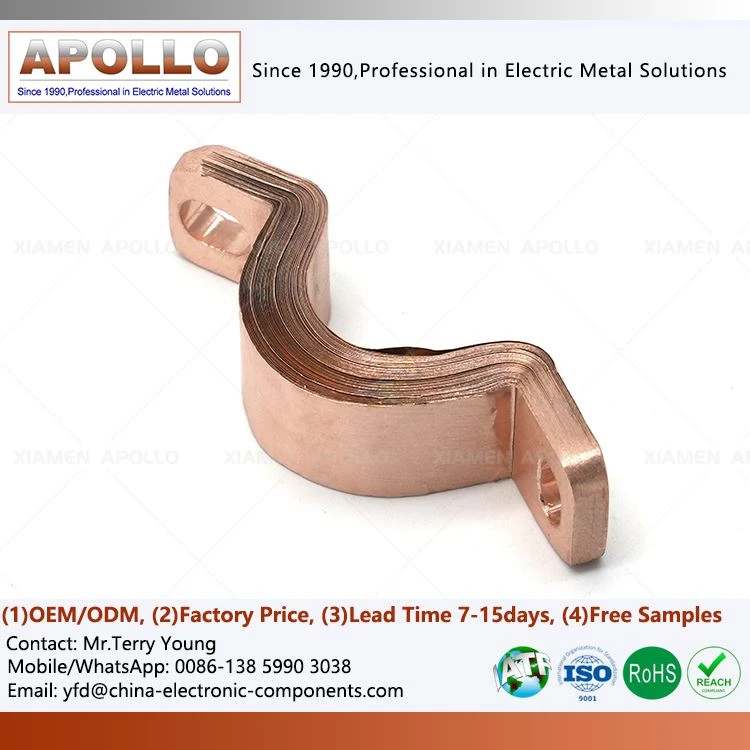
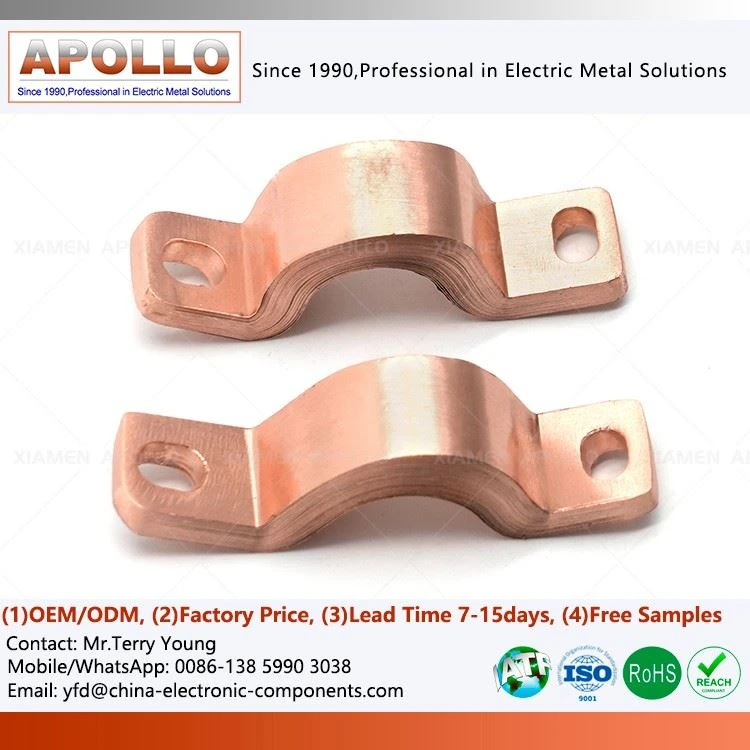
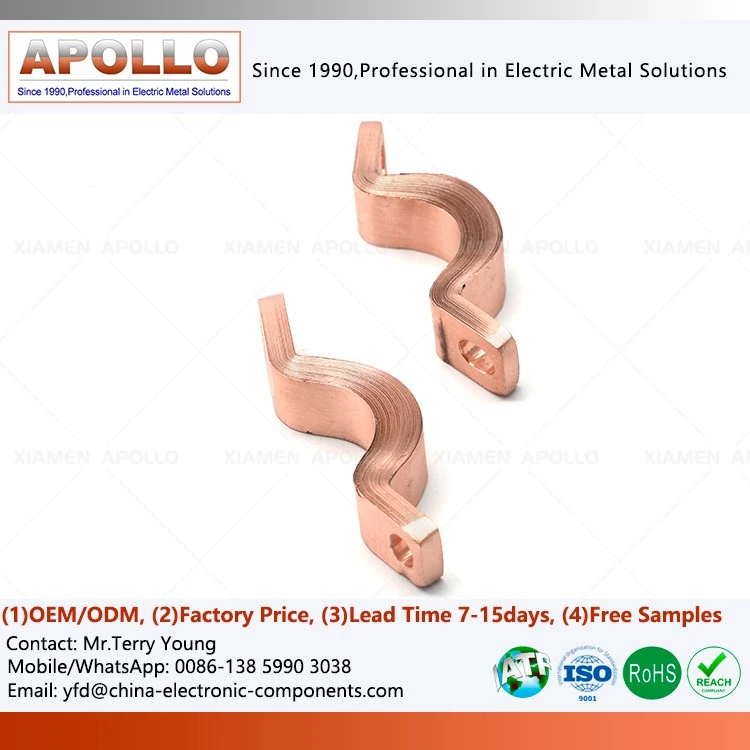
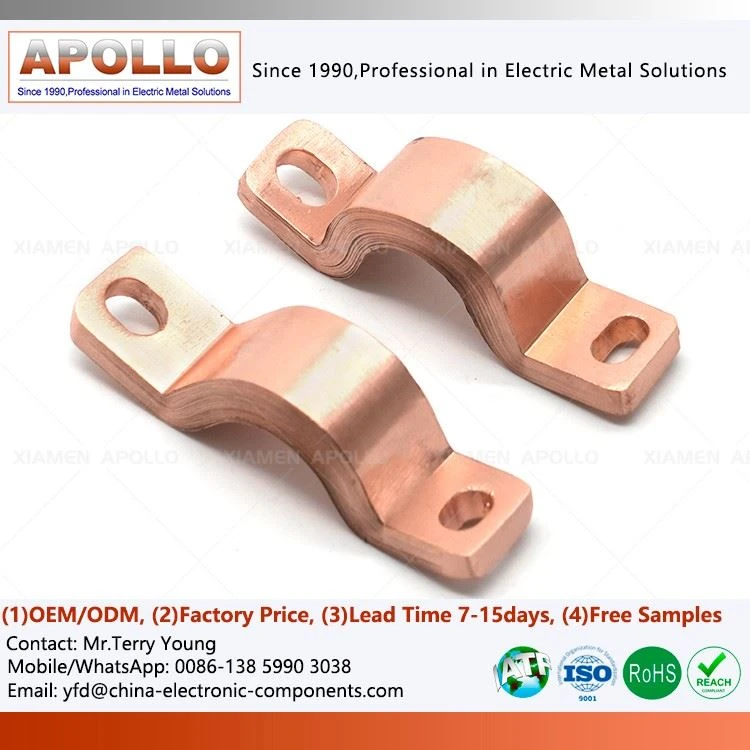
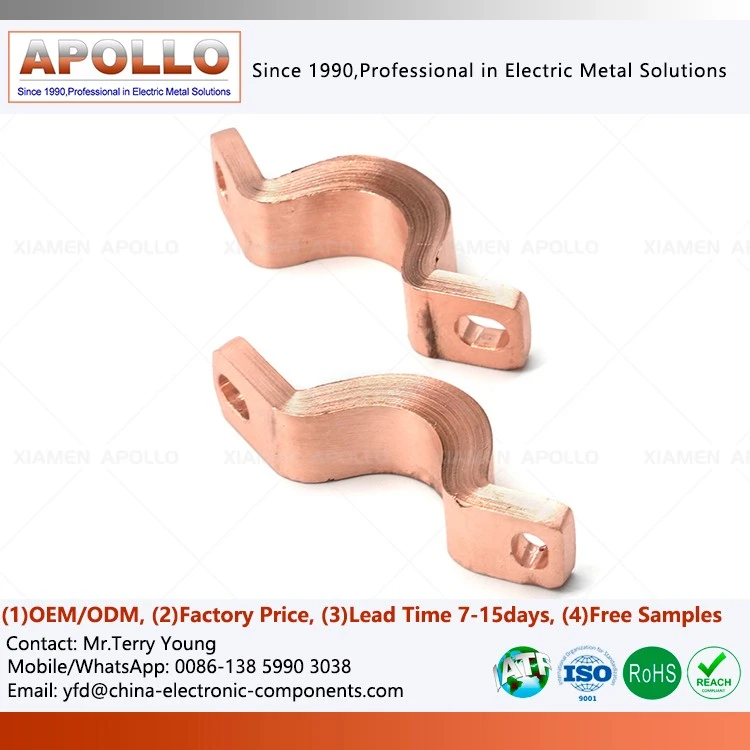
Flexible Laminated Copper Busbar
What is Flexible Laminated Copper Busbar?
This Flexible Laminated Copper Busbar is a functional, flexible conductive connector characterized by a combination of rigidity and flexibility: the contact surfaces at both ends are rigid structures (providing sufficient mechanical strength and installation stability after welding), while the central section retains the flexibility of stacked copper foil layers.
Key Features:
Conductor Material: Made from T2 copper foil (copper content ≥99.9%, conductivity ≥98% IACS), offering excellent electrical conductivity, thermal conductivity, and corrosion resistance. Standard single-layer foil thickness ranges from 0.05 mm to 0.3 mm, with multiple layers stacked to achieve the design's total thickness.
Laminated Structure: Composed of dozens or even hundreds of thin copper foil layers tightly stacked and laminated; there is no insulation between layers, ensuring all layers are electrically connected in parallel. This "multi-layer parallel" configuration provides a larger heat dissipation surface area for a given cross-sectional area.
Contact Surfaces: The stacked copper foils are fused and bonded into a solid unit via polymer diffusion welding, creating a dense copper contact block suitable for subsequent machining operations such as drilling or punching.
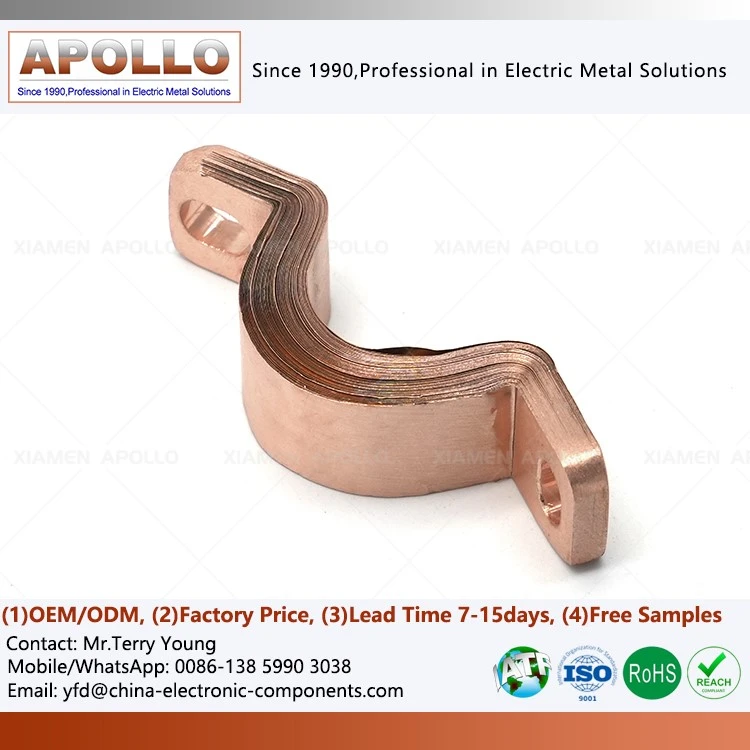
Multilayer Flexible Copper Busbar for Switchgear Differentiation Advantages
| Structural Performance Advantages | Stable current-carrying capacity and high fatigue resistance. The integrated laminated structure ensures ample current-carrying area and uniform current distribution, eliminating risks of localized overheating and making it suitable for continuous high-current operations. |
| Lightweight Integration Advantages | Facilitates equipment miniaturization. Compared to rigid copper busbars, this product is thinner and highly formable, eliminating the need for rigid assembly clearance. This significantly reduces the overall volume and weight of new energy battery packs and power cabinets, aligning with industry trends toward lightweight, integrated, and compact equipment designs. |
| Safety and Protection Advantages | Reliable insulation and low failure rates. Featuring an integrated, sealed insulation structure with a high voltage withstand rating, it effectively resists operational voltage fluctuations and environmental factors like moisture and dust. |
| Assembly Compatibility Advantages | Suitable for automated mass production. With high dimensional precision, consistent geometry, and clean terminal faces, the product is compatible with automated assembly lines. It supports various installation methods-such as welding, bolting, and crimping-meeting the large-scale production needs of new energy vehicle manufacturers and power equipment suppliers while effectively boosting customer production efficiency. |
| Versatile Application Advantages | Covers the full power spectrum. Compact, precision models suit low-to-medium power applications like traction batteries and small energy storage modules, while large, thick models cater to high-power scenarios such as high-voltage distribution cabinets, industrial control equipment, and photovoltaic power plants, providing a one-stop solution for all customer procurement needs. |

Customized Tin Plating Copper Laminated Busbar Technical Features and Design Advantages
Diffusion-bonded composite terminals
Copper foils are fused into a monolithic structure through atomic interdiffusion under high temperature and pressure; the bonding strength at the terminals approaches that of the base material, eliminating the risk of low-temperature solder softening or detaching during high-temperature operation.
01
Full-scale customization
Cross-sectional width, total thickness, number of layers, terminal hole diameter, number of holes, and overall unfolded length can all be customized based on customer 3D models or reverse-engineered from existing samples.
02
3D routing capabilities
Products can be shaped through combinations of Z-axis bending and X/Y-axis translation to fit irregular battery pack geometries and compact electrical cabinet layouts-capabilities that rigid copper busbars cannot match.
03
Menu-style surface treatment options
Choose from or combine three mainstream solutions: tin plating (oxidation resistance and solderability), nickel plating (high-temperature corrosion resistance), and dip-coating insulation (safety protection).
04
Lightweighting benefits
Offers a more compact profile than stranded cables for equivalent current-carrying capacity, helping new energy vehicle OEMs save valuable weight within limited enclosure space.
05

Frequently Asked Questions for Flexible Laminated Copper Bus Bar
Q: Are your flexible copper busbars suitable for 800V high-voltage new energy battery packs?
-
A: Yes. We can customize the number of copper foil layers and the cross-sectional area to meet the current-carrying requirements of 800V high-voltage platforms. Our products withstand operating temperatures ranging from -40°C to 150°C, and the insulation layer meets high-voltage application standards, making them compatible with mainstream high-voltage battery packs.
Q: How much longer is the service life of a molecular diffusion welded joint compared to a traditional brazed joint?
-
A: According to third-party test data, joints made via molecular diffusion welding withstand more than three times the number of bending cycles compared to traditional brazed joints. They do not suffer from delamination or oxidation during long-term high-current operation, offering a service life of over 10 years-thereby meeting the 8-year warranty requirements for new energy batteries.
Q: Can the flame-retardant rating of the insulation layer be specified?
-
A: Yes. Our PVC and TPE insulation layers meet the UL94 V-0 flame-retardant rating. The TPE material features a low-smoke, halogen-free formulation that does not emit toxic gases during combustion, satisfying environmental and safety requirements for sectors such as rail transit and energy storage.
Q: What is the lead time for customized products?
-
A: Depending on manufacturing complexity, the lead time for standard customized products is 12–20 days; delivery schedules for bulk orders can be negotiated. We maintain ample inventory of copper foil raw materials to ensure reliable delivery for mass-production orders.
Q: Can you provide third-party test reports for the products?
-
A: Yes. We can provide relevant quality inspection documents-such as material purity reports, conductivity test reports, temperature rise test reports, and flex-life test reports-to meet the acceptance and compliance requirements of engineering clients.

Contact us
If you are developing battery systems for new energy vehicles, energy storage equipment, or high-power electrical projects, we can provide professional engineering solutions for Tinned Foil Connector for Electrical Battery tailored to your structural designs and application requirements, helping you achieve more reliable and efficient electrical connection designs.
Hot Tags: Flexible Laminated Copper Busbar, Flexible Copper Busbar, Copper Foil Flexible Connector, Laminated Copper Busbar Manufacturer, EV Battery Copper Busbar, Battery Pack Flexible Connector, Copper Foil Soft Connection, High Current Copper Connector, Copper Flexible BusBar, Copper Foil Bus Bar, Copper Foil Flexible Storage Energy Battery Busbar, Copper Foil Multi Layer Welding Busbar, copper foils flexible busbar, Multilayer Copper Foils Flexible BusBars
You Might Also Like


Send Inquiry