











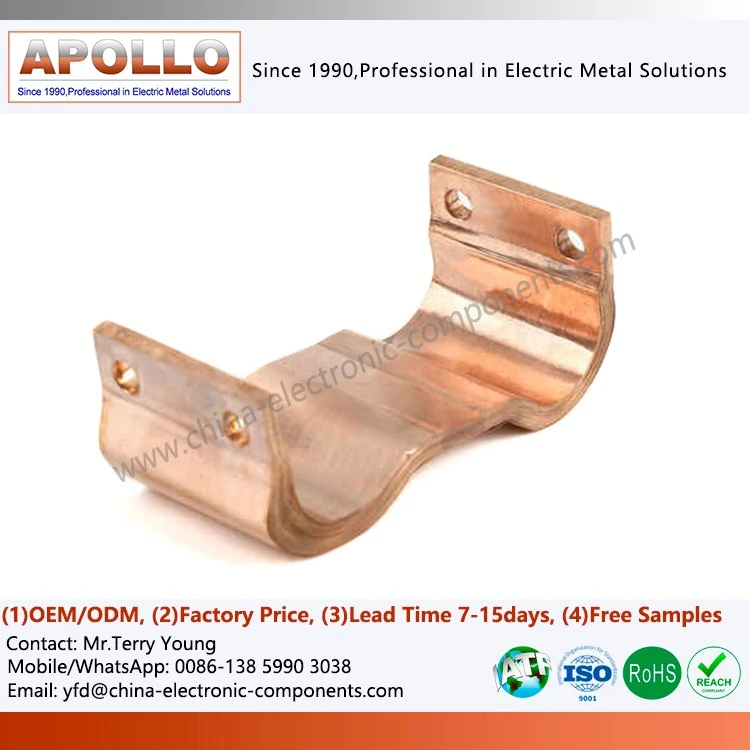


Copper Foil Flexible Connection
Products Description
Copper Foil Flexible Connection is not a traditional rigid copper busbar or braided copper wire, but a third type of conductive interface between solid conductors and flexible cables. It achieves this by precisely stacking tens to hundreds of micron-level annealed copper foils, forming metallurgically bonded hard conductive terminals at both ends, while retaining the micro-slip capability between the foil layers in the middle. This allows for low-impedance bending and multi-degree-of-freedom displacement compensation in three-dimensional space.
Physically, it is a structural-electrical coupling functional component: it not only carries the continuous transmission of large currents but also acts as a "flexible joint" in mechanical systems, absorbing relative displacements caused by thermal cycling, vibration, or assembly tolerances. Small-sized products (cross-sections of tens to hundreds of square millimeters) are mainly used in series connection between modules and high-voltage disconnection circuits in new energy vehicle power battery packs; large-sized products (cross-sections of thousands of square millimeters) serve scenarios such as power transformers, vacuum circuit breakers, electric arc furnaces, and rectifier cabinets, acting as a flexible high-current bridge between fixed busbars and moving parts.

Product Application Classification: Precision Adaptation Across Industries
1. New Energy Power Battery Pack Applications (Small and Refined)
Characteristics: Space-constrained, weight-sensitive, high current density.
Advantages: Our short Flexible Laminated Soft Connector, through ultra-thin foil composites, achieves a minimal turning radius within the compact battery module space, perfectly adapting to the arrangement requirements of stacked or wound cells.
2. Power Appliances and Heavy-Duty Transformer Applications (Large and Stable)
Characteristics: Ultra-high current, long-span displacement, extremely high thermal stability.
Advantages: Used for flexible transitions between generators, transformers, and busbars. Effectively isolates the instantaneous electrodynamic impact during the startup of large equipment and compensates for the thermal expansion and contraction of the Copper Foil Bus Bars caused by changes in ambient temperature.

Technical Features: Molecular-Level Fusion Across Microscopic Interfaces
| Molecular-Level Diffusion Welding Technology | In the end-cap lamination zone, we employ advanced solid-state diffusion welding technology. Driven by high temperature and pressure, atoms between copper foil layers diffuse into each other, forming a metallurgical bond without intermediate phases. This bonding not only gives the end cap macroscopic rigidity comparable to a solid copper busbar but also achieves zero-ohm contact resistance between layers, eliminating the risks of interlayer voids and micro-arc discharge that may occur with traditional processes. |
| Extremely Low and Consistent Milliohm-Level Contact Resistance | Thanks to the uniform thermal field control of diffusion welding, the end cap is free of pores and inclusions, making the current-carrying contribution rate of each copper foil layer approach 100%. The overall voltage drop of the Tinned Foil Connector for Electrical Battery is extremely low, and the temperature rise curve is gradual when carrying continuous high currents, ensuring absolute safety in system thermal management. |
| Ultrasonic non-destructive testing of welds | Each batch of diffusion welds undergoes rigorous ultrasonic C-scan imaging to precisely quantify the weld fusion rate, ensuring that no tiny unfused areas remain in the high-voltage, high-current circuit. |

Detailed Showcase: Engineering Rigor Under the Microscopic Spectrum
Micro-constraint self-locking with end embossing
Before diffusion welding, a specific density of micro-embossing is applied to the end surface. These tiny protrusions undergo localized plastic deformation under pressure, forming a micro-locking mechanism that effectively prevents interlayer slippage and misalignment during high-temperature diffusion, ensuring perfect weld alignment.
Chamfering and passivation of stress relief grooves
At the R-corner area where the connection end meets the flexible section, tiny stress relief grooves are designed for specific operating conditions. All groove bottoms undergo rigorous chamfering and passivation treatment to eliminate stress concentration sources and prevent crack initiation under extreme bending conditions.
Anti-capillary penetration with insulating heat shrink tubing
For battery applications, flame-retardant heat shrink tubing can be optionally installed at the product root, with the inner wall coated with hot melt adhesive. After heat shrinkage, the adhesive layer tightly wraps around the bottom of the Copper Foil Connector, completely preventing electrolyte from seeping into the interior through the interlayer gaps due to capillary action and causing micro-short circuits.
Full coverage of the plating edges
The electroplating process ensures that not only the flat surface but also the microscopic sidewalls of the copper foil's cut surface are completely plated, forming a 360-degree anti-corrosion armor without blind spots, preventing the spread of red rust starting from the edge of the section.

contact us
We not only provide standardized Copper Foil Flexible Busbars products, but also offer integrated engineering support based on customers' battery system structure, current design, and installation environment. This support ranges from conductor solution optimization and flexible structure development to mass production implementation, helping new energy projects achieve more stable and efficient long-term operation.

Hot Tags: copper foil flexible connection, China copper foil flexible connection manufacturers, suppliers, factory, Multilayer Copper Foils Flexible BusBars, Copper Foil Multi Layer Welding Busbar, Flexible Copper Shunts, Copper Flexible BusBar, Copper Foil Connector, Busbar Car
You Might Also Like


Send Inquiry