










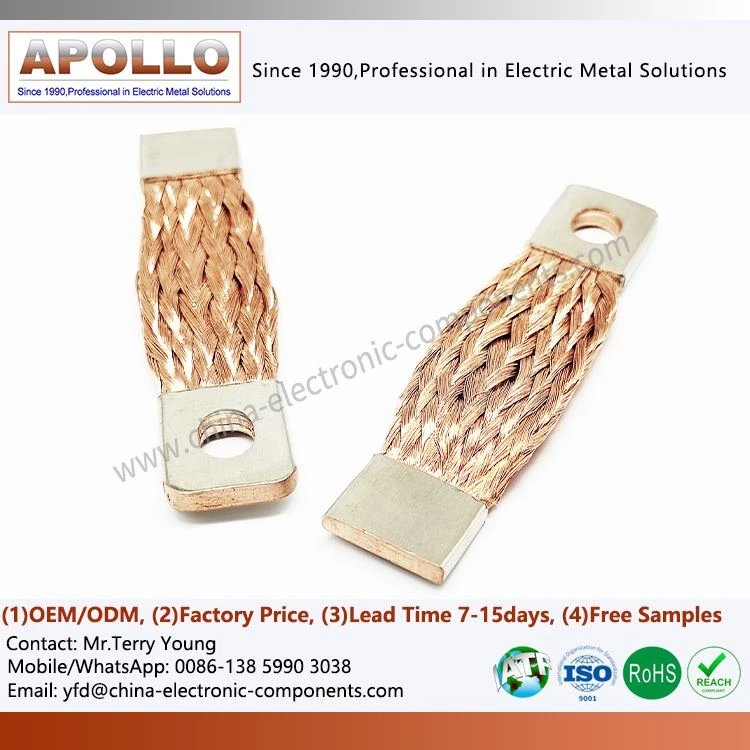


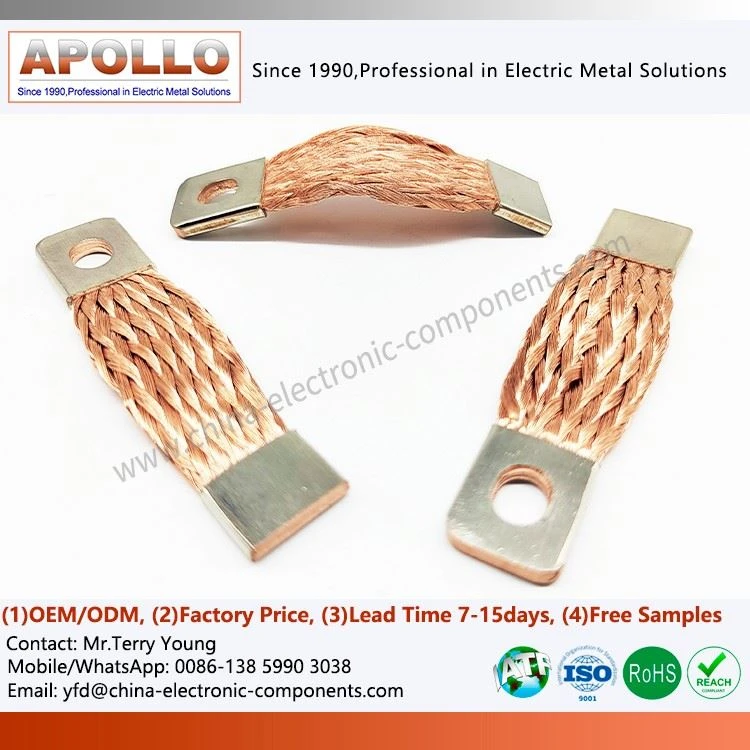

Flexible Copper Braided Connector Bus Bar
Products Description

Unlike traditional rigid copper busbars, the core of Flexible Copper Braided Connector Bus Bars lies in the synergistic design of "conductivity + flexibility." It is not simply a replacement for wires, but a system-level connection solution that balances electrical performance and mechanical adaptability.
The product typically consists of the following structure:
Conductive core: Multiple strands of high-purity copper wire are precisely braided into a strip structure.
Connection ends: Dense joints are formed using crimping, diffusion soldering, or brazing processes.
Surface treatment layer: Tin-plated, silver-plated, or bare copper treatment, depending on the application environment.
Insulation/protective layer (optional): Such as heat shrink tubing, silicone sleeve, or PVC sheath.
This structural design allows it to maintain stable conductivity under complex operating conditions while absorbing mechanical stress.
Key Features and Material Advantages: High Purity Drives High Efficiency
1. Electrolytic Oxygen-Free Copper (T2/C11000): We insist on using electrolytic oxygen-free copper with a copper content of ≥99.95%. This material has a uniform grain size at the microscopic level, ensuring extremely low resistivity and excellent conductivity, minimizing resistance loss and temperature rise during transmission.
2. Surface Treatment Processes (Multiple Protections): Bare Copper: Suitable for standard indoor dry environments.
Tinned Copper: Enhanced oxidation resistance through electroplating or hot-dip tin plating, preventing verdigris formation and improving soldering reliability.
Silver Plated: A top-tier solution for high-frequency applications or extremely low contact resistance requirements for Flexible Busbar and Copper Jumper.

Design Advantages: The Spatial Code of Braided Topological Geometry
| Topological Array of Strand and Spindle Counts | Our design team calculates the optimal "strand count × filament diameter × spindle count" matrix based on the required cross-sectional area using algorithms. Excessively thick filaments lead to a larger bending radius and loss of flexibility; excessively thin filaments cause a surge in production breakage rates. Through rational spatial arrangement, we pack more effective conductive cross-sections into the same volume. |
| Tension Balance of the Braiding Angle | The braiding angle (the angle between the corrugated wire and the axis) is the soul of flexible connection design. Too large an angle turns the product into a rigid tube, unable to absorb stress; too small an angle makes the Flexible Busbar and Copper Jumper prone to loosening, "unwinding," and unable to withstand longitudinal tension. By precisely controlling the pitch of the braiding machine, we lock it at the optimal stress balance angle, ensuring the structural integrity of the product under combined tensile, compressive, and torsional conditions. |
| Angled transition and stress concentration prevention design | At the junction of the braided tape and the tubular end, we abandoned the right-angle transition and adopted a gradually tapering angled design. This makes the electric field distribution more uniform when the current converges from the planar (braided tape) to the point (end hole), avoiding local overheating caused by edge effects for Flexible Copper Braided Connectors. |

Typical Application Scenarios
High-voltage switchgear
Flexible connection between the moving and stationary contacts of a circuit breaker, allowing continuous conductivity when the operating mechanism is activated.
01
Transformers and rectifiers
Transition connection between the low-voltage side busbar and Flexible Copper Braided Electrical Connectors, compensating for thermal displacement.
02
Electric vehicle battery packs
Braided Copper Flexible Connectors connected in series or parallel between modules, absorbing vehicle vibration.
03
Bus trunking junction boxes
Flexible transition between the plug and the internal Copper Braided Flex Connectors, facilitating installation and maintenance.
04
Electroplating/electrolysis power supplies
Flexible connection between the high-current rectifier cabinet and the electrode, Braided Flexible Power Shunts, withstanding frequent start-stop cycles and temperature fluctuations.
05

contact us
If your project has higher requirements for connection reliability, structural adaptability, and long-term stable operation, we can provide customized CU Flex Busbar solutions based on actual working conditions. You are welcome to submit technical parameters to obtain engineering-level matching support.

Hot Tags: flexible copper braided connector bus bar, China flexible copper braided connector bus bar manufacturers, suppliers, factory, Braided Connectors, Copper Tinned Wires, Grounding Braids Wire Tin Plated, Braided Wire Flexible Copper, Lithium ion Batteries Connectors, Braided Flexible Copper BusBar
You Might Also Like


Send Inquiry