










Technical Analysis of Server Cabinet Equipment Configuration: Key Factors in Data Center Infrastructure Planning and Efficient Operations & Maintenance
Aug 20, 2026
Leave a message
With the rapid development of cloud computing, big data, artificial intelligence, and enterprise digital operations, data centers and enterprise server rooms have placed higher demands on server cabinet configurations. Server cabinets not only house core hardware-such as servers, network equipment, and power systems-but also directly influence system cooling efficiency, power stability, network reliability, and the quality of ongoing operations and maintenance.
Proper server cabinet configuration requires comprehensive planning that accounts for equipment types, business scale, scalability needs, and the operating environment. Every aspect-from structural design, power system configuration, and network cabling to thermal management and intelligent monitoring-directly impacts the long-term stability of the IT infrastructure.
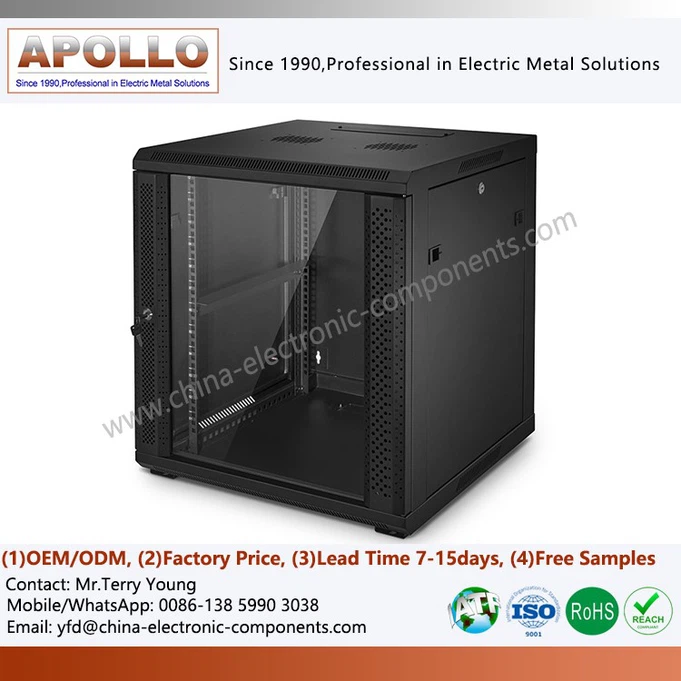
Server Cabinet Selection and Space Planning
As fundamental infrastructure in data centers, the choice of server cabinet specifications must fully consider both current equipment volume and future expansion requirements. Standard cabinets typically feature a height of 42U and widths of 600mm or 800mm; depths are selected based on the dimensions of the servers, switches, and power equipment, ranging from 800 mm to 1000 mm to as much as 1200mm.
During the planning phase, it is common practice to reserve some redundant space within the cabinet to avoid the need for reconfiguring the server room layout when expanding equipment. Adequate space allocation not only facilitates the future addition of servers but also optimizes cable management and equipment maintenance.
For scenarios with significant space constraints-such as small server rooms, edge computing nodes, and office environments-compact cabinet solutions are often employed; for instance, a 22U rack can meet the deployment needs of various small-to-medium-sized network and computing devices. In contrast, large-scale data centers prioritize high-density server deployment capabilities and the overall load-bearing capacity of the cabinets.
Internal cabinet layouts generally adhere to the principles of "heavy items at the bottom, light items at the top" and "hot/cold aisle separation." Heavier components-such as UPS units, battery modules, or storage arrays-are typically installed in the lower section to minimize structural stress risks, while lighter equipment like switches and patch panels is placed higher up. Additionally, airflow paths for intake and exhaust are carefully planned to mitigate issues with localized overheating.
Server Equipment Configuration and Computing Capacity Planning
Servers serve as the core computing units within the cabinet system, and their configuration must be tailored to specific business applications. Different application scenarios impose varying requirements regarding processor performance, memory capacity, storage speed, and network bandwidth.
General-purpose servers are primarily used for enterprise applications, databases, and web services; they typically feature multi-core processors, high-capacity memory, and high-speed solid-state storage to meet daily operational needs.
High-density servers prioritize computing power per unit of space, utilizing 1U or 2U chassis designs to integrate more computing resources within limited rack space. These devices are suitable for virtualization platforms, cloud computing nodes, and large-scale data processing environments.
For tasks such as AI training, scientific computing, and deep learning, GPU servers require high-performance computing cards paired with high-speed interconnects to achieve enhanced large-scale parallel computing capabilities.
Regarding installation, rack-mount designs allow servers to be installed systematically in standard cabinets, improving management efficiency while facilitating future maintenance, replacement, and expansion.
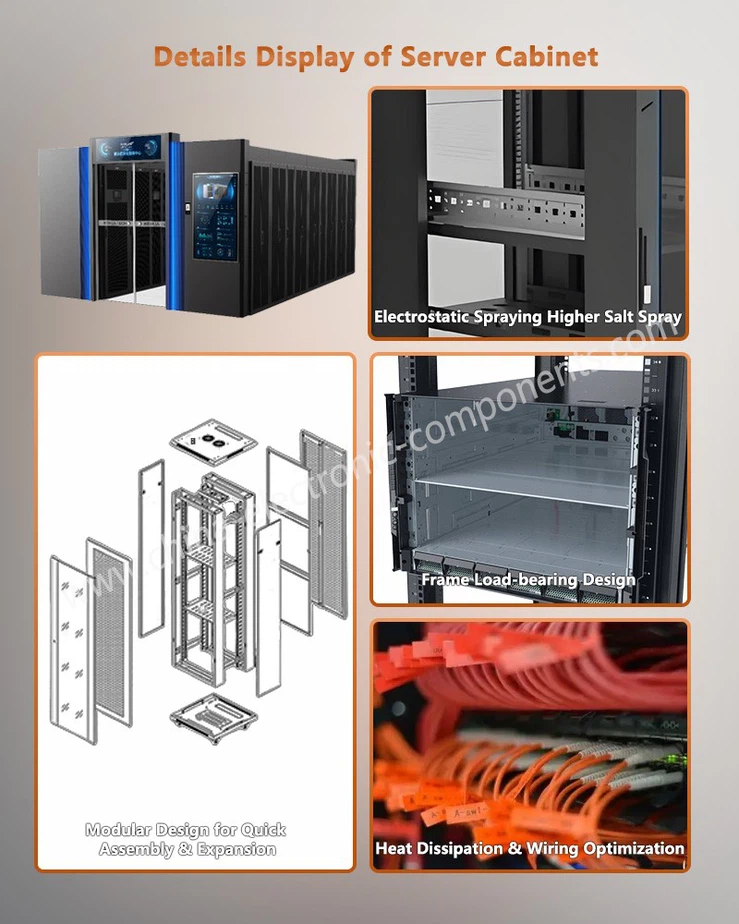
Network Equipment and Cabinet Cabling System Design
The network system serves as the vital foundation for data transmission within a data center; internal cabinet network design must balance high-speed transmission, low latency, and maintainability.
Core switching equipment typically handles data exchange between multiple cabinets and must support high-speed ports and network redundancy. As data traffic continues to grow, 40G, 100G, and even 400G network interfaces are becoming the standard direction for large-scale data centers.
Access switches are matched to server network interface speeds-for instance, 25G server network cards require corresponding switches to ensure efficient data transmission between computing resources and the network.
In addition to the production network, the management network is a crucial component of the cabinet system. An independent management network enables remote device monitoring, fault diagnosis, and system maintenance, thereby boosting operational efficiency.
During cabinet cabling, power cables and data communication lines must be strictly separated to minimize electromagnetic interference. Furthermore, the use of cable management panels, cable labels, and standardized routing methods helps reduce the complexity of future maintenance.
For home offices and small business network environments, home network cabinets provide a compact space for equipment management, allowing for the centralized installation of routers, switches, and small servers.
Power Systems and Reliability Assurance
A stable power supply is essential for the continuous operation of servers and network equipment. Cabinet power system designs must account for redundancy, load capacity, and protection mechanisms for abnormal conditions. Server equipment typically employs a dual-power-supply design, with each supply connected to a separate power line to prevent equipment downtime caused by a single-path failure.
Cabinets are usually equipped with Power Distribution Units (PDUs) to provide standardized power interfaces for servers, switches, and other devices. Current capacity should be calculated based on equipment power requirements, incorporating an appropriate safety margin.
For mission-critical environments, Uninterruptible Power Supply (UPS) systems are essential to maintain operations during mains power anomalies and prevent data corruption caused by sudden power outages.
In high-density computing environments, power management becomes even more critical. Intelligent PDUs enable real-time monitoring of power, current, and load status for each output port, allowing for the early detection of potential risks.
Thermal Management and Environmental Control
As server computing power increases, the power density per cabinet rises, making thermal management a key factor in data center reliability.
Traditional cabinets typically utilize a front-to-back airflow pattern; designs incorporating "cold aisle" and "hot aisle" configurations minimize the mixing of cold and hot air, thereby improving cooling efficiency.
High-performance servers generate significant heat during operation; therefore, equipment placement must be carefully planned to centralize high-power devices and ensure cold air effectively reaches the equipment's intake zones.
For specialized applications-such as outdoor communication nodes-ruggedized outdoor network cabinets are required to withstand temperature fluctuations, dust, and humidity.
In noise-sensitive settings like laboratories, offices, or specialized computing environments, soundproof server racks can be used to mitigate operational noise.
Temperature and humidity monitoring systems are also vital components of modern server rooms. Sensors collect real-time environmental data from within the cabinet, while intelligent management platforms dynamically adjust cooling strategies to enhance energy efficiency.
Cabinet Security Management and Intelligent O&M
Server cabinets must not only accommodate equipment installation but also provide robust security management capabilities.
Regarding physical security, cabinets are typically equipped with electronic access control systems, mechanical locks, and video surveillance to log and manage personnel access and equipment operations, thereby reducing the risk of unauthorized activity.
In terms of intelligent management, protocols such as SNMP and Modbus enable centralized monitoring of the cabinet environment, power status, and equipment operational health.
Intelligent O&M platforms allow administrators to remotely view server status, analyze energy consumption trends, and detect equipment anomalies early, ultimately improving overall operational efficiency. For small-scale server deployment environments, home server cabinets offer centralized equipment management capabilities, ensuring a more organized installation of network hardware in home labs, small businesses, or R&D settings.
Cabinet Scalability and Future-Proof Design
As business operations expand, server cabinet configurations must support long-term scalability.
Regarding network design, plans should account for future high-speed network upgrades and reserve space for higher-bandwidth equipment. In terms of power systems, modular UPS units and scalable power solutions should be adopted to accommodate the future addition of equipment.
For space-constrained environments, wall-mount solutions-such as wall-mount rack enclosures and 6U vertical wall-mount racks-enable the flexible deployment of network and small-scale computing equipment.
Furthermore, the planning phase should anticipate factors such as server growth, increased power capacity, and rising cooling demands to avoid the additional costs associated with future retrofitting.
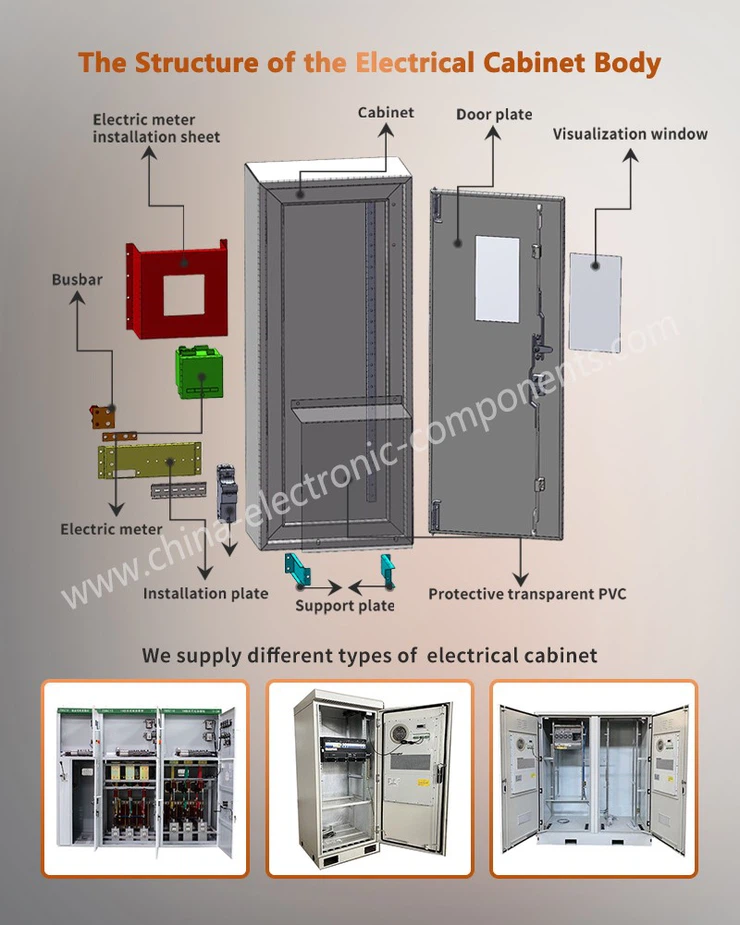
Industry Trends in Server Cabinets
Future developments in server cabinets will increasingly focus on high density, high reliability, and intelligent management.
Driven by the growth of AI computing, large-scale data centers, and edge computing, server cabinets must support equipment with higher power densities and more complex data processing capabilities.
Key areas for industry advancement include modular design, intelligent monitoring, efficient cooling, and green energy-saving technologies.
Simultaneously, as enterprise digital infrastructure shifts toward distributed models, demand for compact cabinets, edge computing cabinets, and flexible deployment solutions will continue to rise.
Configuring server cabinet equipment is a systematic process that requires a comprehensive assessment of equipment performance, power supply, network connectivity, thermal management, security, and future scalability. Through strategic planning and sound design, organizations can build stable, efficient, and sustainable IT infrastructure that reliably supports digital transformation.
contact us
Send Inquiry